YouTube Browse Feed 2026: What YouTube Actually Documents
If you narrowed your channel because a post told you YouTube now sorts creators into micro-niche clusters and penalizes anything off-topic, read the source documents before you delete a video. YouTube's own performance FAQ tells creators the opposite: "It's important that you always keep experimenting with new topics and formats." Here is what YouTube documents, what it does not, and how that changes the way you judge a niche.
Did YouTube announce a February 2026 Browse feed overhaul?
Not in anything YouTube has published that we could find. The claim runs through creator-tool blogs published in early 2026, each describing viewer "clustering" by micro-niche, and each citing another blog rather than YouTube. YouTube's Creator updates log for February 2026 records one item: a Studio mobile app version cutoff.
We checked three places a recommendation change would surface: the Creator updates log, YouTube's two Help pages describing how the recommendation system works, and Neal Mohan's 2026 letter. None of them describes broad topic categories being replaced by watch-history clusters, and none uses the phrase "micro-niche."
Missing paperwork is not proof the systems stood still. YouTube adjusts ranking continuously and does not publish every change. What it does mean is narrower and more useful: the specific object creators are being told to optimize for — a channel-level cluster label that videos either match or break — has no documented existence. Tactics built on that object are built on a blog post.
Does YouTube score your channel or your videos?
Videos, matched to audiences. YouTube's performance FAQ states: "Our systems rely more on video and audience-level signals to decide which videos are the best recommendations for your audience." The unit under judgment is a video paired with a viewer, not a channel grade you carry from upload to upload.
That distinction changes the diagnosis when views fall. The same FAQ names the cause directly: "What can lead to a decline in overall channel views is when viewers stop watching most of your videos when they're recommended to them." That is a satisfaction problem inside individual videos, not a filing problem across your library.
Two documented signals do operate at channel level — subscriptions, and a viewer choosing "Don't recommend channel." Both are viewer decisions about you, not classifier decisions about your topic mix. The same confusion shows up in niche research versus keyword research, where volume gets mistaken for durability.
Should you unlist videos that do not fit your niche?
No. The advice circulating in 2026 tells creators to audit their last 20 uploads and unlist anything off-topic. YouTube's guidance points the other direction, and the mechanics work against you: an unlisted video "won't appear in the Videos tab of your channel homepage" and will not surface in search.
Think about what you are throwing away. A video that underperformed with your core audience is often the one that reached an adjacent audience — the exact expansion path a niche channel needs at 1,000 subscribers. Unlisting removes it from distribution going forward while leaving every watch-history signal it already produced untouched. You lose the inventory and keep nothing.
The honest version of this advice is about what you upload next, not what you bury. If three of your last ten videos found a different audience than the other seven, that is data about where your channel is drifting. Deleting the evidence does not stop the drift.
Which recommendation signals does YouTube actually name?
YouTube's recommendation system page lists them explicitly: watch history, interest affinity, content performance, search behavior, likes, shares, comments, "Not interested" feedback, survey responses, channel subscriptions, and content language preferences. Two terms that dominate 2026 creator advice — "content cluster clarity" and "audience fit score" — appear on none of YouTube's pages.
Interest affinity is the one worth understanding, because it is where niche strategy actually lands. YouTube describes it as recognizing "a viewer's favored themes, topics, and formats." That is a property of the viewer, built from what they watched. It is not a label stamped on your channel.
The practical test YouTube offers creators is a reframe, quoted from the same page: instead of asking "Does the algorithm like my content?", ask "Does my audience like this?" Invented metric names give you something to chase. That question gives you something to check in your own analytics.
So what does committing to a niche actually buy you?
Audience overlap that compounds. When the people who finished your last video have the interest affinity your next video matches, your own back catalog becomes the warmest distribution you have. The niche is not a category you are filed under — it is the reason two of your videos want the same viewer.
This is why a scattered channel struggles without any classifier punishing it. If video one satisfies woodworking viewers and video two satisfies personal finance viewers, neither video helps the other find its audience. You are running two channels at one upload rate, and both start cold. Nothing has to penalize you for that arithmetic to hurt.
The same arithmetic prices a pivot. If commitment buys audience overlap rather than a cluster score, then changing direction costs you that overlap — not a hidden mark against the channel. YouTube tells creators to keep experimenting with new topics and formats, which is why the pivot penalty is smaller than the commitment framing implies: you start cold again, and that is the entire bill.
It also explains why one outlier is luck and three across channels is a signal. A single video reaching a new audience tells you almost nothing. The same format outperforming across several channels means a group of viewers exists whose affinity you can serve repeatedly.
How do you tell whether your niche is working?
Read four numbers in YouTube Studio and compare each against your own previous 90 days. YouTube publishes no benchmark for any of them, so any post handing you a threshold — "under 20% Browse traffic means you are underperforming" — invented it. Your trend line is the only comparison with meaning.
| Signal | Where to read it | What a rising number means |
|---|---|---|
| Returning viewers | Analytics → Audience → Returning viewers | The same people come back. This is niche commitment paying off. |
| Browse traffic share | Analytics → Traffic sources → Browse features | YouTube is matching you to viewers who did not search for you. |
| Format concentration | Your top 5 videos by views, last 90 days | Your best performers share a format. That format is your anchor. |
| Audience overlap | Analytics → Audience → What your audience watches | Your viewers watch a coherent set of other channels — a real niche exists around you. |
If returning viewers stay flat across two quarters while your upload count rises, the problem is not your topic label. The people arriving are not staying, and no amount of cluster tidying reaches that. Fix satisfaction inside the videos first, which is what YouTube's own decline explanation points at.
Can a small channel still get discovered in 2026?
The platform has shipped mechanisms aimed at exactly that. Hype is live in 39 countries, open to Partner Program channels with 500 to 500,000 subscribers, and viewers get up to three hypes per week. YouTube states the boost scales inversely with subscriber count: fewer subscribers, bigger bonus.
Scale gives the rest of the picture. Mohan's 2026 letter reports Shorts averaging 200 billion daily views and more than 1 million channels using YouTube's AI creation tools daily in December 2025. Distribution is not scarce. Attention from a specific group of viewers is, and that is the thing a niche concentrates.
Subscriber count gates the paid surfaces, though not the way it is usually described. The Partner Program asks for 1,000 subscribers with 4,000 qualified watch hours in the last 12 months, or 1,000 subscribers with 10 million qualified Shorts views in the last 90 days. Channel memberships carry no separate subscriber bar — YouTube's fan funding requirements say the channel has to be in the Partner Program first. One gate feeds the rest, so if those thresholds drive your planning, the watch-hour math behind niche selection matters more than any feed theory.
Key takeaways
- No YouTube documentation describes a February 2026 Browse feed change from broad categories to micro-niche clusters. The claim traces to creator-tool blogs citing each other.
- YouTube states its systems rely on video and audience-level signals, and names falling per-video satisfaction as what drives overall channel views down.
- YouTube tells creators to keep experimenting with new topics and formats. Unlisting off-topic videos removes them from your channel's Videos tab and search, and recovers nothing.
- "Content cluster clarity" and "audience fit score" appear in no YouTube documentation. Interest affinity, a property of the viewer, is the documented mechanism.
- Judge your niche by returning viewers, Browse share, format concentration, and audience overlap — each against your own last 90 days, because YouTube publishes no benchmark.
Choosing where to concentrate is the decision underneath all of this, and it happens before you have any analytics to read. Gleam scores demand against competition for a niche using public YouTube data, so the comparison you are making is between measured options rather than between two hunches. See what your niche scores.
Ready to find your next video idea?
Gleam helps you discover content gaps and outlier videos with real YouTube data.
Start Free TrialRelated Articles
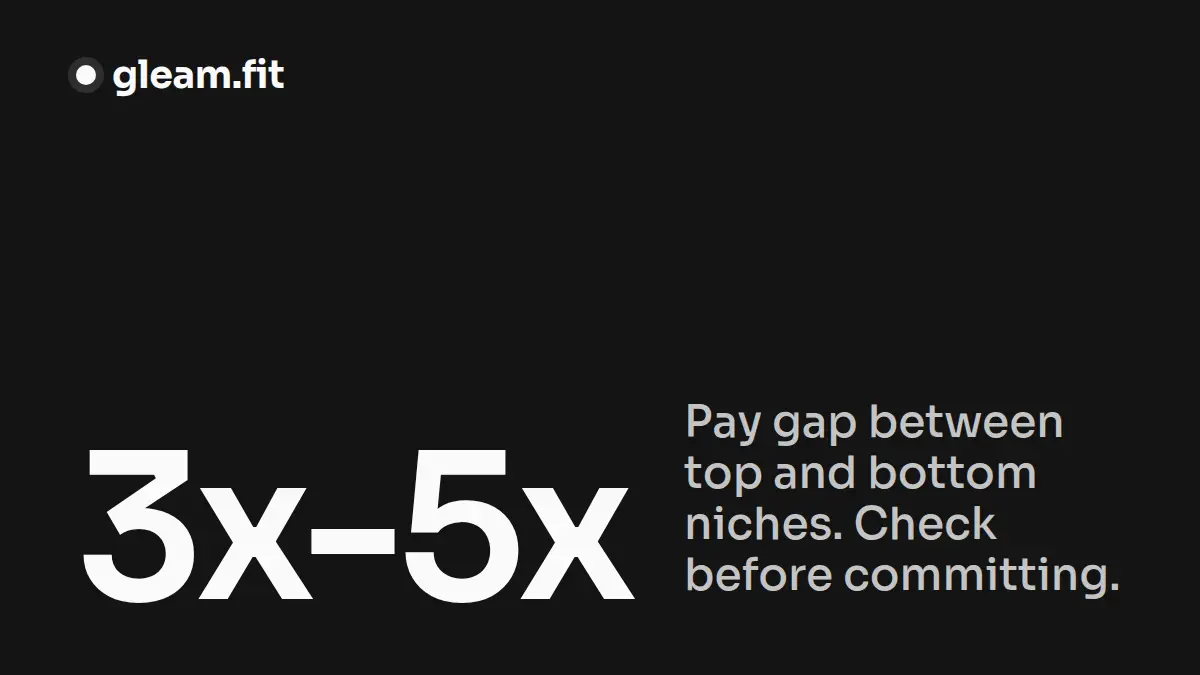
YouTube CPM by Niche: How to Read a Niche's Pay Ceiling Before You Commit
Two YouTube niches with the same views can earn very different money. A niche sets its CPM band the day you pick it — here's how to read that pay ceiling before you commit.
One Outlier Is Luck. Three Across Channels Is a Niche Signal
One viral outlier can be luck. When the same format outperforms across several channels in a niche, it signals demand you can read before you commit.
How YouTube's 2026 Browse Feed Rewards Niche Commitment
The 2026 micro-niche clustering claim traces to blogs citing each other. Here is what YouTube documents about niche commitment, and where it contradicts.