When to Change Your YouTube Niche: A Data-Driven Framework
You picked a niche. You posted consistently. Months later, your channel is flat. The obvious next step feels like changing your niche — but that decision should come from data, not frustration. Before you pivot, you need to know whether the problem is your niche or your execution. This framework uses two metrics you already have — CTR and audience retention — to give you a clear answer.
How Do You Know If It's a Niche Problem or an Execution Problem?
You tell them apart by looking at click-through rate (CTR) and audience retention together, not separately. CTR tells you whether your packaging — title and thumbnail — attracts attention. Retention tells you whether the content delivers after the click. When one is healthy and the other is weak, the fix is execution. When both are weak, the niche itself may be the issue.
Most creators skip this step. They see flat subscriber counts and assume the topic is wrong. But according to YouTube's official impressions FAQ, half of all channels and videos on YouTube have a CTR between 2% and 10%. If you fall inside that range, your packaging is functioning. The question becomes what happens after the viewer clicks.
This distinction matters because a niche pivot resets your channel's topic authority — the algorithm's understanding of what your channel is about and who should see it. According to OutlierKit's analysis of YouTube algorithm updates, the 2026 Browse feed now clusters videos based on viewer watch history patterns rather than broad topic categories. A pivot forces that clustering to start over. If execution was the real problem, you just lost months of algorithmic learning for nothing.
What Does the CTR × Retention Matrix Tell You?
The matrix maps four combinations of CTR and retention, each pointing to a different root cause. Treat it as a diagnostic tool, not a final verdict — but it narrows down where to focus your effort before making a big decision like changing your niche.
High CTR, low retention. Viewers click but leave quickly. Your title and thumbnail create curiosity, but the video doesn't match the promise. This is a classic packaging-content mismatch. As the Humble&Brag YouTube agency notes in their 2026 CTR benchmark report, YouTube now evaluates what happens in the 30 seconds after a click — a concept they call "Quality CTR." A strong thumbnail that leads to a weak opening gets penalized fast. The fix is in your intros and content structure, not your niche.
Low CTR, high retention. Few people click, but those who do stay. Your content is solid — the topic resonates with the people who find it. But your title and thumbnail aren't compelling enough to stop the scroll. This is a packaging problem. Test different thumbnail styles, rewrite titles with clearer viewer benefit, and compare your CTR by traffic source. A video with 3% browse CTR but 10% search CTR doesn't have a CTR problem — it has a browse packaging problem.
High CTR, high retention. Both metrics are healthy. If growth is still slow, the issue is likely volume or frequency, not the niche. YouTube's algorithm needs enough data points — enough videos — to understand your channel and recommend it consistently.
Low CTR, low retention. Few click, and those who do leave early. This is the one combination that points to a genuine niche or topic problem. The audience YouTube is showing your video to isn't interested in the topic, and the content isn't holding the small group that does click. If this pattern holds across 30+ videos with varied titles and thumbnails, the niche may not have enough demand — or you may be targeting the wrong audience within a viable niche.
How Many Videos Should You Commit Before Deciding?
Give a niche at least 50 videos before drawing conclusions about whether it works. According to data from YouTube Scribe's Growth Calculator, channels typically need 50 to 100 videos for the algorithm to develop a clear understanding of their content and audience. The first 20 to 30 videos are a learning phase — for you and for YouTube.
This doesn't mean 50 random uploads. Each video should target a specific topic within your niche, with intentional title and thumbnail testing. If you post one video per week, 50 videos takes about a year. That timeline aligns with what multiple growth studies report: most channels see their first meaningful traction after 6 to 12 months of consistent uploads.
Why 50 and not 10? Early videos carry high variance. A single video can flop because of a weak thumbnail, bad timing, or a topic that's too narrow. With 50 videos, you have enough data to see patterns. Which topics get more impressions? Which have higher retention? Where does CTR spike or drop? These patterns are invisible with a small sample.
Creator and YouTube strategist Dexxter Clark puts it simply: videos typically need about 3 months to reach their full potential in views per day, and some take over a year. Judging a niche after a handful of underperforming uploads is like judging a restaurant after one bad meal — you don't have enough information yet.
When Should You Actually Pivot Your Niche?
Pivot when you've posted 50+ videos, tested multiple title and thumbnail approaches, and your CTR and retention are both consistently below your niche benchmarks. That means you've eliminated execution as the variable, and the remaining explanation is topic-audience fit.
There are also non-data signals worth weighing. According to Subscribr's pivot guide for advanced creators, three qualitative triggers matter: you dread creating content in your current niche (sustainability risk), your long-term goals have shifted away from the topic, or you've discovered a related niche with higher demand and less competition that genuinely excites you.
But even when the data and the qualitative signals align, pivot strategically. A niche that shares audience overlap with your current one lets you retain some viewers. A complete pivot — say, from cooking to gaming — essentially means starting a new channel with the baggage of an old one. In many cases, starting fresh is the better move. As OutlierKit's YouTube niches guide notes, niche-focused channels grow faster because the algorithm can precisely match content to interested viewers. A confused channel identity slows that matching down.
What Happens to Your Channel When You Pivot?
Expect a temporary drop in impressions and engagement. YouTube's recommendation system has built a profile of your audience based on your existing content. When you change topics, that profile becomes inaccurate, and the algorithm needs time to rebuild it.
The 2026 algorithm update makes this both harder and easier. Harder because the Browse feed now uses tighter viewer clusters — a pivot means your old cluster no longer applies. Easier because the system is better at finding the right viewers for focused content. If your new niche is clearly defined and your first 10 to 15 videos in the new direction perform well, the algorithm can recalibrate faster than it could a few years ago.
Some subscribers will leave. That's expected. The goal isn't to keep every subscriber from your old niche — it's to attract a new audience that matches your new direction. Creators who try to serve both audiences at once end up with diluted signals that confuse the algorithm and slow growth in both directions.
If the overlap between old and new niche is minimal, consider a second channel. You keep your original channel's authority intact and give the new topic a clean algorithmic slate. This is a common pattern among creators who've successfully pivoted — they treat it as a new product launch, not a renovation.
Niche Pivot Decision Checklist
Have you posted at least 50 videos in your current niche?
Have you tested at least 3 different thumbnail and title styles?
Is your CTR consistently below your niche benchmark across traffic sources?
Is your retention below 40% across most videos?
Have you checked whether the problem is topic selection within the niche (not the niche itself)?
Does the new niche have measurable search demand?
Can you sustain content creation in the new niche for 12+ months?
Is there audience overlap — or should you start a new channel?
If you answered yes to the first five, the data supports a pivot. If you answered yes to the last three, you have a viable destination. The worst outcome isn't a failed niche — it's pivoting to another niche without fixing the execution issues that caused the first one to stall.
Ready to find your next video idea?
Gleam helps you discover content gaps and outlier videos with real YouTube data.
Start Free TrialRelated Articles
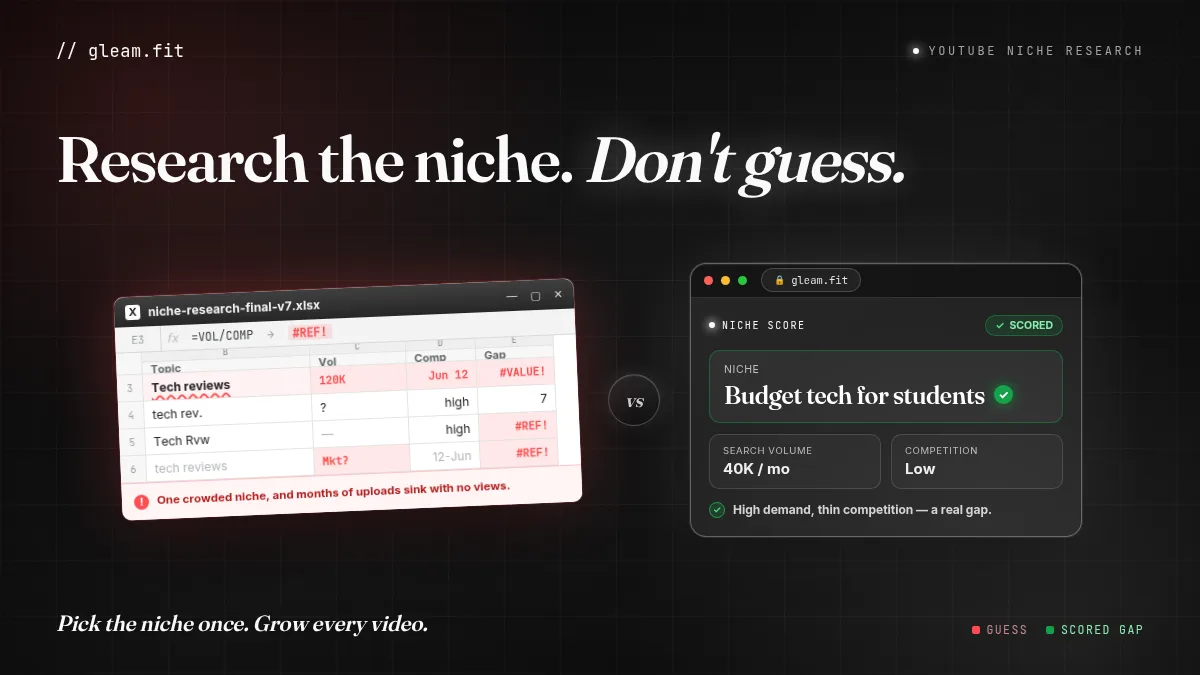
How to Research a YouTube Niche in 4 Reads
Most creators check search volume and commit. A repeatable four-read method — demand, competition structure, reachability, and revenue fit — to weigh a YouTube niche before you choose it.
YouTube Returning Viewers: The Metric That Predicts Growth
Views are a lagging indicator. Return viewer rate predicts whether your channel will grow. Here's the benchmark and how your niche affects it.

YouTube Traffic Sources: Why Search Drives Growth
YouTube recommendations drive 70% of watch time, but small channels can't access most of it. Search is the real entry point.