Why YouTube's AI Slop Cleanup Helps Small Niche Channels
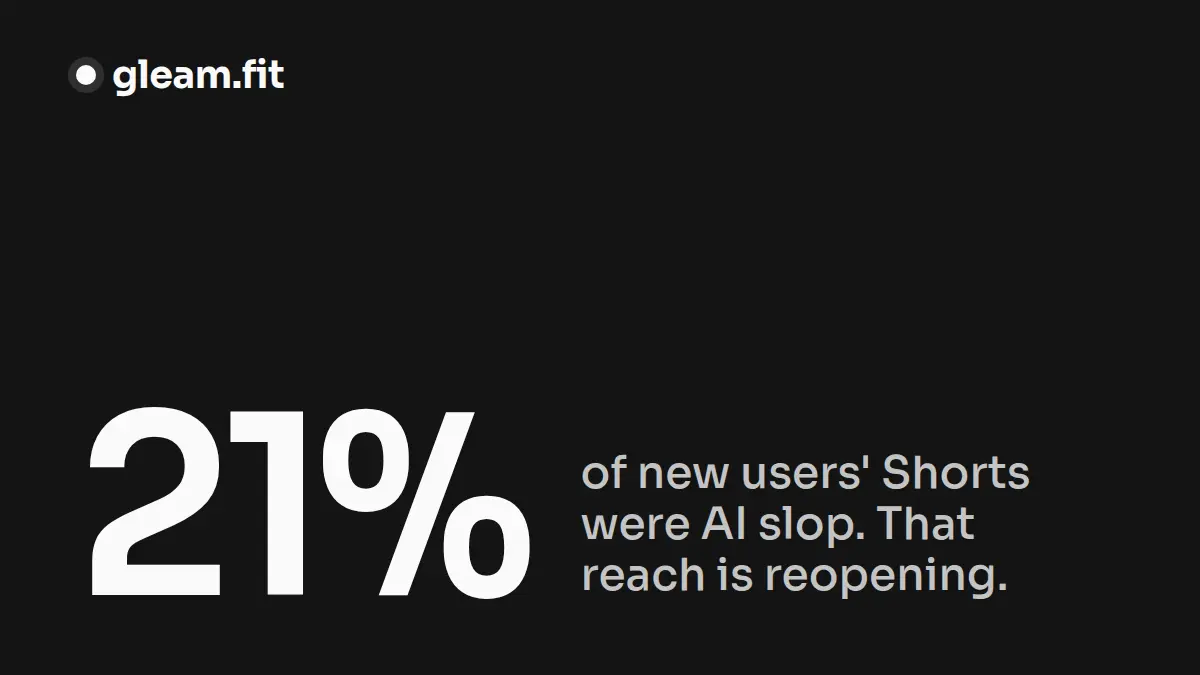
YouTube terminated 16 channels in January 2026. The wipe erased 4.7 billion lifetime views and 35 million subscribers from the platform — roughly $10 million in annual ad revenue gone overnight. A Kapwing study of 15,000 trending channels found that 21% of Shorts shown to new users were AI-generated low-quality content, what YouTube CEO Neal Mohan now openly calls "AI slop." That share of platform reach is not vanishing. It is being reallocated. And the channels best positioned to absorb it look nothing like AI slop — they look like the structural opposite of it. The inauthentic content policy YouTube uses to define slop also defines, by inverse, what protects small niche channels. This is how that redistribution works.
What just happened to AI slop on YouTube?
YouTube began a coordinated enforcement wave against mass-produced AI content in January 2026. CEO Neal Mohan named the target — "AI slop" — in his annual letter on the YouTube Official Blog, and the platform terminated or wiped content from 16 high-reach channels in the weeks that followed.
The policy foundation was already in place. On July 15, 2025, YouTube renamed its "repetitious content" policy to "inauthentic content" and clarified that the rule covers content "that looks like it's made with a template with little to no variation across videos, or content that's easily replicable at scale." The rename was not cosmetic. It expanded enforcement scope from upload patterns (repetition) to creative authenticity (template-driven output regardless of surface variation).
In his 2026 letter, Mohan wrote that YouTube was "actively building on our established systems that have been very successful in combatting spam and clickbait, and reducing the spread of low quality, repetitive content." Days later, Tubefilter and Dexerto reported that YouTube had removed 11 channels outright and wiped the content from 6 more. The 16 affected channels held a combined 4.7 billion lifetime views, 35 million subscribers, and approximately $10 million in annual ad revenue.
YouTube has been careful to distinguish slop from AI itself. Mohan noted in the same letter that "more than 1M channels used our AI creation tools daily in December." The line is not between AI and not-AI. The line is between content with meaningful human editorial judgment and content that is template-driven enough that an average viewer cannot tell one upload from the next.
How much reach did AI slop actually hold?
The reach AI slop held inside YouTube's recommendation system was larger than most creators realized. Kapwing's November 2025 study of 15,000 trending channels — the top 100 in every country surveyed via playboard.co — identified 278 channels producing AI slop exclusively. Together those channels held 63 billion lifetime views, 221 million subscribers, and approximately $117 million in estimated annual ad revenue.
The distribution share was the more striking number. When Kapwing's researchers created a fresh YouTube account with no preferences and scrolled through the first 500 Shorts the algorithm served, 21% of those Shorts were AI-generated. An additional share fell into a broader "brainrot" category — compulsive, repetitive content optimized purely for retention loops — putting 33% of cold-start Shorts in low-quality territory overall.
The Guardian reported in late 2025 that nearly 10% of YouTube's fastest-growing channels were AI slop. Across both metrics — distribution share and growth rate — slop was claiming reach that should have been going somewhere else.
That is the share now opening up. YouTube's enforcement does not destroy demand for the underlying viewer attention. It reallocates it. When the recommendation system stops surfacing slop channels into a cooking feed, the next-best content in that feed gets surfaced instead. The redistribution operates per category, per language, per viewer interest cluster.
Why does YouTube's policy protect niche channels by definition?
The inauthentic content policy defines what slop is. By doing so, it also defines — in inverse — what is safe. The YouTube Help Center states the test directly: "if the average viewer can clearly tell that content on your channel differs from video to video, it's fine to monetize."
This is a structural test, not a topical one. The policy does not penalize same-niche channels. It penalizes same-template channels. Two videos can both be about French cooking — they can share the same niche, the same target audience, the same keyword cluster — and still read as different to a human viewer because the recipe is different, the framing is different, the on-camera judgment is different.
That is the protection a niche channel gets automatically. When a small creator picks a niche and operates inside it for 20 uploads, they generate two signals at once. The first is consistency — the channel reads as having a clear topic identity, which the 2026 algorithm rewards with stable distribution. The second is variation — every video inside that niche reflects different angles, different questions, different framings, because a human is making editorial choices about what to cover next. Niche consistency and human variation are not in tension. They are the combination the policy is explicitly designed to protect.
The third element from the policy text is also worth quoting: "This policy applies to your channel as a whole." Channel-level evaluation cuts both ways. One template-driven video can pull down monetization for an entire channel that otherwise has good content. The reverse is also true: a track record of channel-wide variation creates a buffer that a single off-pattern video cannot puncture.
What does this mean for a small niche channel right now?
The categories where AI slop had the largest reach are also the categories where redistribution is largest. According to Kapwing's analysis, slop concentrated in cooking and recipe content (AI-narrated channels like Super Recipes and SuperYummy crossed 1 million subscribers and 400 million views with AI voiceover over recipe footage), kids' content (channels like Bandar Apna Dost and Pouty Frenchie accumulated billions of views with AI-generated scenarios targeting children), and music or quiz formats. These categories share three traits: templated formats worked, production cost was the main barrier, and the content did not require proven on-camera expertise.
A small niche channel operating in any of these categories — or adjacent to them — now competes against a thinner field. The slop channels were ranking in those interest clusters precisely because there was viewer demand and limited authentic supply. As enforcement continues, the openings widen.
Two things matter most for a small channel positioning to absorb that redistribution. First, every video on the channel should pass the average-viewer-can-tell-the-difference test by a clear margin — not the bare minimum. The bare minimum is risky in a channel-level evaluation regime. Visible editorial choices, an on-camera or vocal presence, opinions stated with specificity, and structural variation between uploads all generate the signal.
Second, AI tools are not the risk; over-reliance on AI without editorial judgment is. A creator who uses AI to draft research notes and then films and edits the video themselves is operating well within the policy. A channel where every upload uses the same AI voiceover template over the same kind of slideshow is not, even if the topics differ.
The redistribution is not a guarantee. It is an opportunity per category. The channels that absorb it will be the ones already positioned with niche identity and visible human judgment before the algorithm finishes reallocating.
How can you tell if your channel is positioned for this redistribution?
If you want to audit where your channel stands against the policy and the redistribution opportunity, run through these five checks:
Can an average viewer tell each of your last 20 videos apart, beyond the title and thumbnail?
Is your channel topic clear enough that a viewer could describe it in one sentence after watching three videos?
Are your editorial choices — cuts, structure, framing, commentary — visible on every upload?
If you use AI tools, can a viewer still see your judgment in the final video?
Is your niche category one where AI slop previously held meaningful reach share?
Yes to the first four, and yes to the fifth, points to the strongest positioning. The slop reach is not redistributing evenly. It is redistributing to the channels the policy was structurally designed to reward.
Ready to find your next video idea?
Gleam helps you discover content gaps and outlier videos with real YouTube data.
Start Free TrialRelated Articles
Some YouTube Niches Reward Formats YouTube Won't Monetize
YouTube just named three content types it won't monetize — templated, off-putting, and fake-AI-expert. The catch for new creators: that risk is set the day you pick a niche. Here's how to score a niche's format exposure before you commit.
YouTube Niche Research Tools: 5 Checks Before You Pay
Before you pay for a YouTube niche research tool, run it against the five checks that actually decide a niche: real demand, median competition, CPM, outlier proof, and freshness.
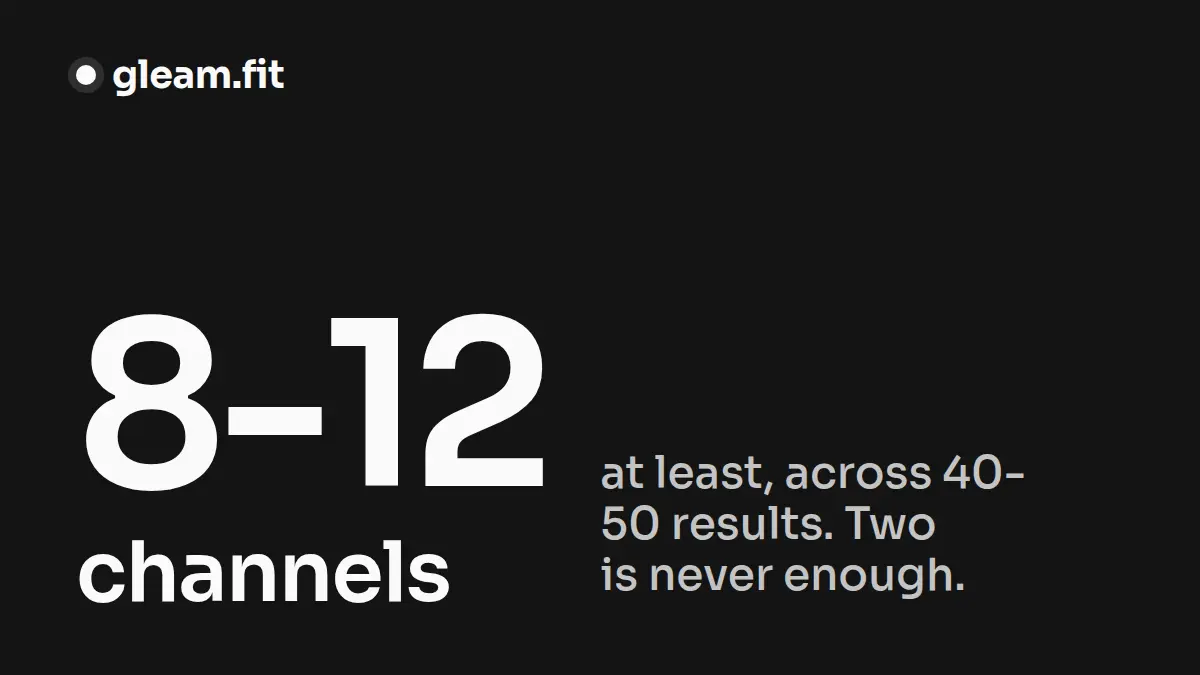
How Many Channels Should You Analyze Before Choosing a YouTube Niche?
Two channels isn't a sample. Here's how much competitor data you actually need, the three skew traps that ruin a small read, and a checklist to tell when your YouTube niche research is solid enough to film against.