YouTube CTV: Why Niche Channels Win the Living Room
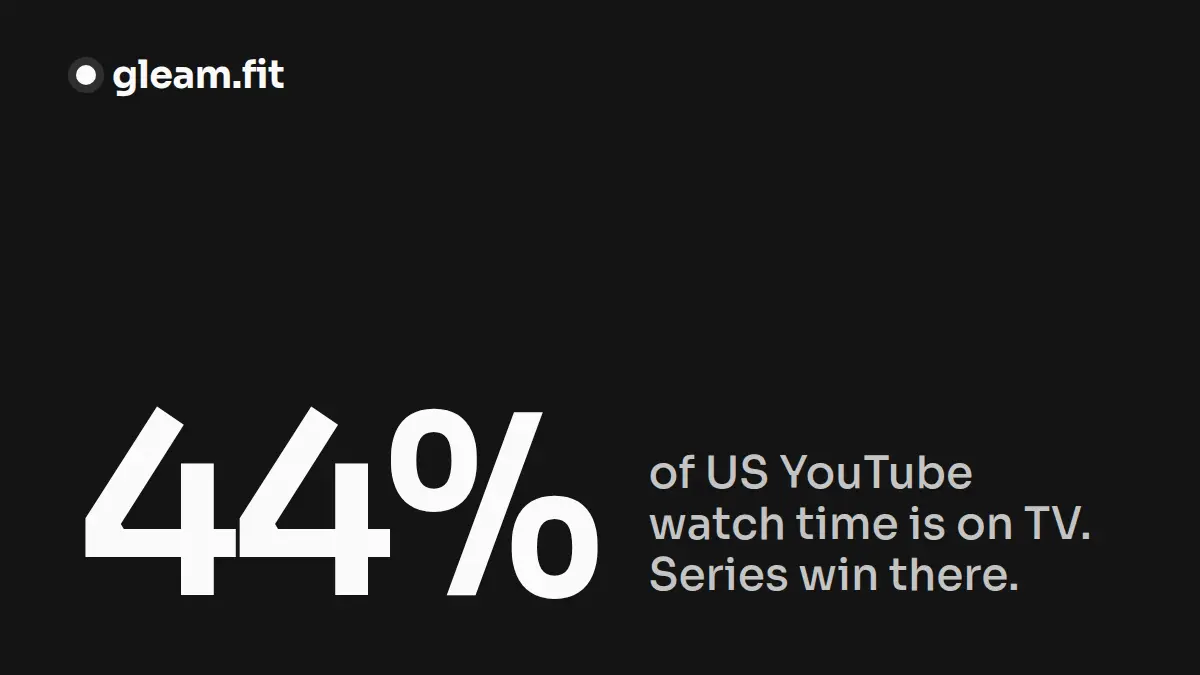
YouTube is no longer just a mobile platform. In September 2026, it captured 12.6% of all US streaming time — more than any other streamer — and over 44% of US YouTube watch time now happens on connected TV (CTV). That shift quietly changes which channels grow, and the living room turns out to favor niche channels with episodic structure over broad, mixed-topic feeds. Here is why, and how to adapt.
Why does YouTube on TV behave differently from YouTube on mobile?
The TV is a lean-back screen, not a scroll-and-swipe screen. Mobile viewers hunt the next short hit; TV viewers settle in for an evening. According to eMarketer data shared with TechCrunch in April 2026, connected TVs now account for over 44% of US YouTube watch time, up from about 41% in 2022. That shift redefines what "good content" means.
On mobile, retention is measured in seconds. A viewer scrolling the home feed gives a thumbnail two seconds, maybe less, before swiping. The algorithm rewards sharp hooks and tight openers because that is the survival math of a phone session.
On TV, the survival math is different. The viewer is on the couch. They have already committed to "watching YouTube" instead of Netflix or cable. They are not looking for the next viral hit — they are looking for the next thing to lean into for 20, 40, sometimes 60+ minutes. According to YouTube CEO Neal Mohan, "for more and more people, watching TV means watching YouTube. But the new television does not look like the old television."
This is not a niche behavior either. Connected TVs are now the dominant device for YouTube viewing in the US, ahead of smartphones. The platform overtook Disney in TV viewing time, and is widening its lead over Netflix — US adults are projected to spend more time on YouTube than on Netflix in 2026, according to eMarketer. The competitive set has shifted entirely. YouTube is no longer competing with TikTok for a 30-second moment. It is competing with Netflix, Disney+, and Pluto TV for an evening.
What does YouTube actually reward on connected TV?
YouTube rewards continuous, predictable viewing. CEO Neal Mohan made episodic series a 2026 priority, and YouTube launched Creator Show Pages in its TV app — a Netflix-like layout where channels are organized into seasons and episodes. The platform is signaling clearly: it wants creators to think like TV producers, not viral video makers.
The product cues line up with the strategy. Christian Oestlien, YouTube's VP of product management, told The Hollywood Reporter that creators are leaning into "20 to 40 minute videos with a season arc and multiple episodes," and that the lean-back TV environment "really lends itself to" binge episodic experiences. Show Pages were built so a fan can land on a channel and immediately see Season 1, Season 2, and the episodes inside each.
According to a Fourthwall analysis of YouTube's 2026 roadmap, longer watch times and lean-back viewing create stronger conditions for monetization, especially for channels producing episodic series, documentaries, or cinematic videos. The platform is no longer optimizing only for "next clip" — it is optimizing for "next episode."
Mohan put it bluntly: the new television is interactive, and it includes Shorts, podcasts, and livestreams — all consumed on the biggest screen in the house. Combined with product changes like Show Pages and immersive previews, the message is consistent. YouTube is rebuilding the TV experience around persistent creator brands rather than one-off recommendations, and creators who match that structure get the upside.
Why can't broad channels survive in the living room?
A broad channel — one that posts cooking, then travel, then finance — cannot promise the next episode. There is no theme to season, no payoff to lean into, no reason to autoplay. The TV viewer who lands on a broad channel sees a buffet, not a show. Niche channels, by contrast, can promise the same payoff every single video.
This is a structural problem, not a content quality problem. A broad channel can have great videos. But on a TV, the viewer is asking a question the channel cannot answer: "What am I about to watch for the next 30 minutes?" If the answer changes every upload, the autoplay queue is unpredictable, and the lean-back viewer gets up and switches platforms.
The algorithm sees this in the data. When YouTube tries to recommend "the next episode" from a broad channel on TV, it has to guess across unrelated topics. The session ends. The channel loses the kind of session-time signal that drives sustained recommendation in lean-back contexts.
Niche channels avoid the guessing game. Same theme every video. Same audience signal. Same payoff. The TV does not have to predict what comes next — the channel itself is the prediction.
How should niche creators structure for TV viewing?
Treat your channel like a TV show. Group videos into thematic playlists that act as "seasons." Use Creator Show Pages if you have access. Plan content arcs across multiple uploads, not one-off hits. The shift is conceptual: stop thinking in videos, start thinking in series.
A few practical implications:
Playlist as season: Group 6–10 videos under a single arc. Order them so episode N sets up episode N+1. Do not just dump uploads chronologically.
Channel page as channel guide: Pin a hero video that explains what your "show" is. New TV viewers should understand the format in 30 seconds.
Episode titles, not isolated titles: Title videos so they read as part of a series, not as standalone search bait. "Niche Audit #4: Why Your Sub Count Lies" reads differently from "Why Your Sub Count Lies."
Length follows context: Mobile favors short hooks; TV favors 20–40 minute deep cuts. If you have not tested a long-form arc, your TV growth potential is unknown.
None of this requires high production value. It requires structure. The channels winning the living room are not the cinematic ones — they are the ones a viewer can predictably return to.
Is your channel TV-ready? A quick checklist
Run your channel through these five questions. If you answer "no" to two or more, your channel is built for the phone but not the living room.
Season structure: Does each video belong to a clear arc, series, or playlist that functions as a season?
Next episode discoverability: Can a TV viewer find your "next episode" in under three clicks from any video?
Playlist ordering: Are your playlists arranged like episodes — set up, payoff, escalation — or are they random collections?
Channel identity in 30 seconds: Would a new TV viewer understand what your channel is "about" within the first 30 seconds of any video?
Autoplay retention: When YouTube autoplays your next video on TV, does the viewer stay in your channel — or jump to a different creator entirely?
The 44% CTV milestone is not a future trend. It is the current center of gravity for US YouTube watch time. Mobile-first thinking still works for discovery and Shorts, but the channels that compound from here are the ones built for the screen people sit in front of, not the screen they swipe through.
Niche is no longer just an SEO advantage or a CPM advantage. On TV, niche is a structural one — because only niche channels can credibly promise the next episode.
Ready to find your next video idea?
Gleam helps you discover content gaps and outlier videos with real YouTube data.
Start Free TrialRelated Articles
YouTube Not Interested: Why Hidden Feedback Kills Your Reach
YouTube's "Not Interested" clicks are invisible to creators but quietly shape your channel's reach. Here's how they work and why niche focus is your defense.

YouTube Traffic Sources: Why Search Drives Growth
YouTube recommendations drive 70% of watch time, but small channels can't access most of it. Search is the real entry point.

YouTube Thumbnail CTR: Why More Clicks Can Kill Your Channel
High CTR can hurt your channel when the wrong people click. Here is how quality clicks and niche clarity drive real growth.