YouTube Niche Research: Read the Titles, Not Just the Keywords
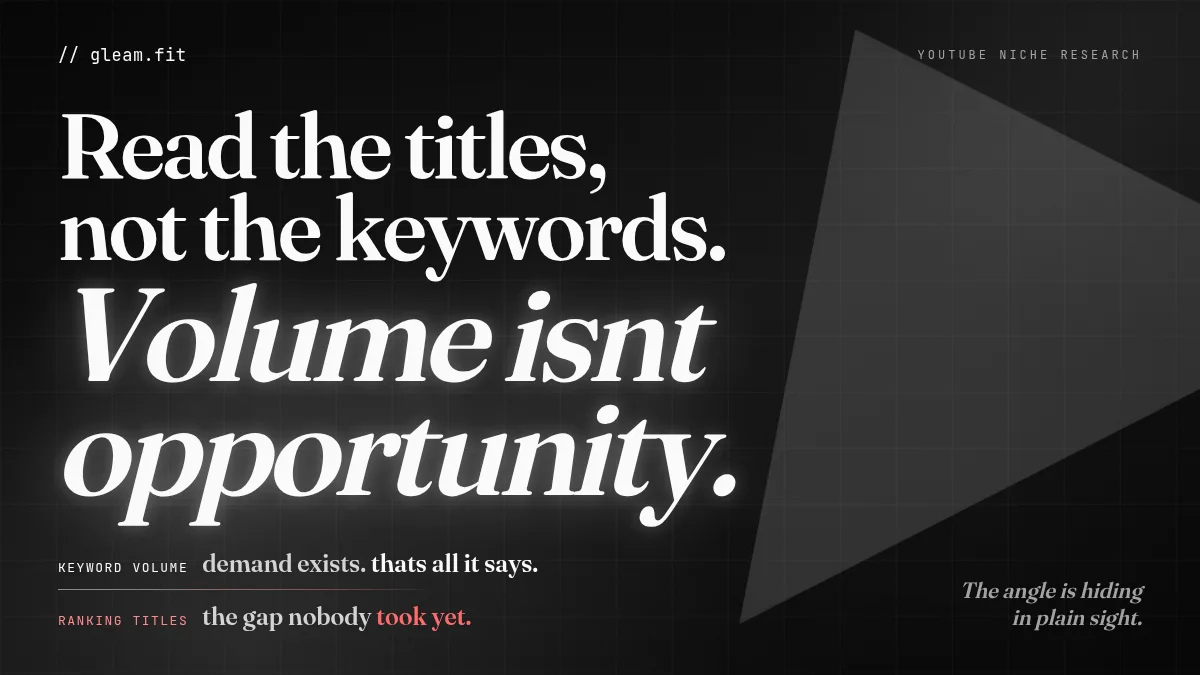
Most YouTube niche research stops at one number: search volume. You find a keyword, check how many people search it, glance at a competition label, and decide. But the videos already ranking for that keyword carry far more information than the keyword string ever could. Their titles are a map of how the audience frames the topic, which formats win, and — most usefully — which angle every channel is repeating and which one nobody has taken yet. This post is about reading that map before you commit months to a niche.
Why isn't keyword volume enough to research a YouTube niche?
Search volume tells you a topic has demand, but not whether there is room for your angle. A keyword is one number; the titles ranking under it are the actual content already serving that demand. Volume says "people want this." The titles say "this is exactly how everyone is answering it" — which is the part that decides whether you blend in or stand out.
This is the gap in the standard advice. Mainstream guides from tools like vidIQ, TubeBuddy, and Semrush (secondary sources) walk you from a strength topic to demand validation to a competition score. That sequence is fine, but it treats the niche as a number to be rated. It rarely asks you to read what is already published. Two niches can show identical volume and competition labels while the titles ranking in them tell completely different stories — one a crowded echo chamber, the other a topic everyone covers from a single tired angle.
What do the titles already ranking tell you that keywords can't?
Titles reveal the audience's real question framing and the format consensus. When the top results for a keyword all promise the same thing — "X tips," "X for beginners," "X in 2026" — that repetition is the signal. It shows the angle every creator agreed on, which means the opening is the angle none of them took. Keywords can't show you that; titles can.
Read the ranking titles for any keyword and three things surface quickly. First, the framing: are these tutorials, lists, reactions, deep dives, or debates? That tells you what the algorithm and audience currently reward in this niche. Second, the consensus angle: the phrase or promise that repeats across most titles. Third, the white space: the question a viewer would still have after watching all of them. A niche where every title is a beginner tutorial has an obvious gap for the intermediate creator who got stuck after the basics — and you only see that gap by reading the titles, never by reading the volume.
There is a reason small creators are told to study competitors directly rather than trust a score. Creator guides repeatedly point to small or mid-sized channels with unusually high views as the strongest signal of an open keyword (secondary creator sources). But "study the competitors" is vague. The concrete version is: read their titles as a set, and look for the promise that is missing from all of them.
How do you read the title landscape for a content gap?
Treat the ranking titles as one document, not a list of rivals. Pull the top results for your exact keyword, read every title together, and note the words and promises that repeat. The recurring language is the consensus framing; the question those titles leave unanswered is your entry angle. Then sanity-check that the gap has demand, not just absence.
A practical pass looks like this. Search the specific keyword you would build around — not a broad category like "finance," but the phrase a viewer would actually type. Read the titles of the top ranking videos as a group. Group them by the angle they take. If one angle dominates, the underserved angles are your candidates. Then ask the discipline question: is the missing angle missing because nobody wants it, or because nobody has done it yet? A gap with no demand behind it is a trap, not an opportunity — which is why title-reading is the first move, not the only one. You still confirm demand direction and competition before you commit.
The reason to read titles before you read scores is that a score compresses the niche into a label, while titles preserve the texture you need to find an angle. A "medium competition" badge hides whether the field is ten near-identical tutorials or ten genuinely different takes. Only the titles tell you which.
What does gleam actually show you about ranking titles?
When you search a keyword, gleam pulls the top ~50 ranking videos and shows their actual titles, then extracts the recurring language from those titles, tags, and descriptions into Suggested Keywords. So you see both the raw title landscape and a frequency-ranked view of the words that repeat across it — the consensus framing, surfaced from what is genuinely working right now.
Two parts do the work here. The result set is the real ranking videos, titles included, so you can read the field as a document instead of guessing. And the Suggested Keywords panel is built by extracting terms from those titles (weighted most heavily), their tags, and descriptions, then refining them — its label reads, plainly, "Extracted from titles, tags & descriptions." That extraction is frequency-based: it surfaces which words and phrases recur, which is exactly the consensus signal you want when hunting for the missing angle.
Alongside the titles, gleam shows supporting structure for the demand sanity-check: competition based on the median competing channel (so one giant channel doesn't distort the read), how many unique channels appear in the results, how fresh the top videos are, and which direction demand is moving. Those numbers tell you whether a gap you spotted in the titles actually has room and demand behind it.
Two honest limits. gleam does not classify "the missing angle" for you — there is no feature that reads the titles and announces the gap, and no title-quality or format score. The extraction is frequency and phrase counting, not interpretation. gleam shows you what is ranking; finding the white space in it is your read, made faster because the field and its recurring language are in front of you instead of scattered across a search page. It is a commit-time check on a keyword you give it, not an oracle that picks your angle.
What should you check before you commit to a niche angle?
Before you build months of videos around a niche, run the exact keyword you would target through a title-first read, then confirm the gap has demand. The point is to enter with an angle the field is missing, not the angle everyone already took. Walk this short checklist on your specific keyword:
- Did I read the actual titles of the top ranking videos as a set — not just check the search volume?
- What promise or framing repeats across most of those titles? That is the consensus angle to avoid copying.
- What question would a viewer still have after watching all of them? That is your candidate angle.
- Is that missing angle missing because of no demand, or just because no one has done it — and does demand point up or stable, not down?
- Is competition Low or Mid by median channel size, with enough unique channels that two or three creators don't own the topic?
- Are the top videos stale or thin enough to leave room for a fresher, sharper take?
Search volume gets you to the door of a niche. The titles already inside it tell you whether there is a seat left and where it is. Read them before you commit, and you enter with an angle of your own instead of the one the algorithm has already heard a hundred times.
Ready to find your next video idea?
Gleam helps you discover content gaps and outlier videos with real YouTube data.
Start Free TrialRelated Articles
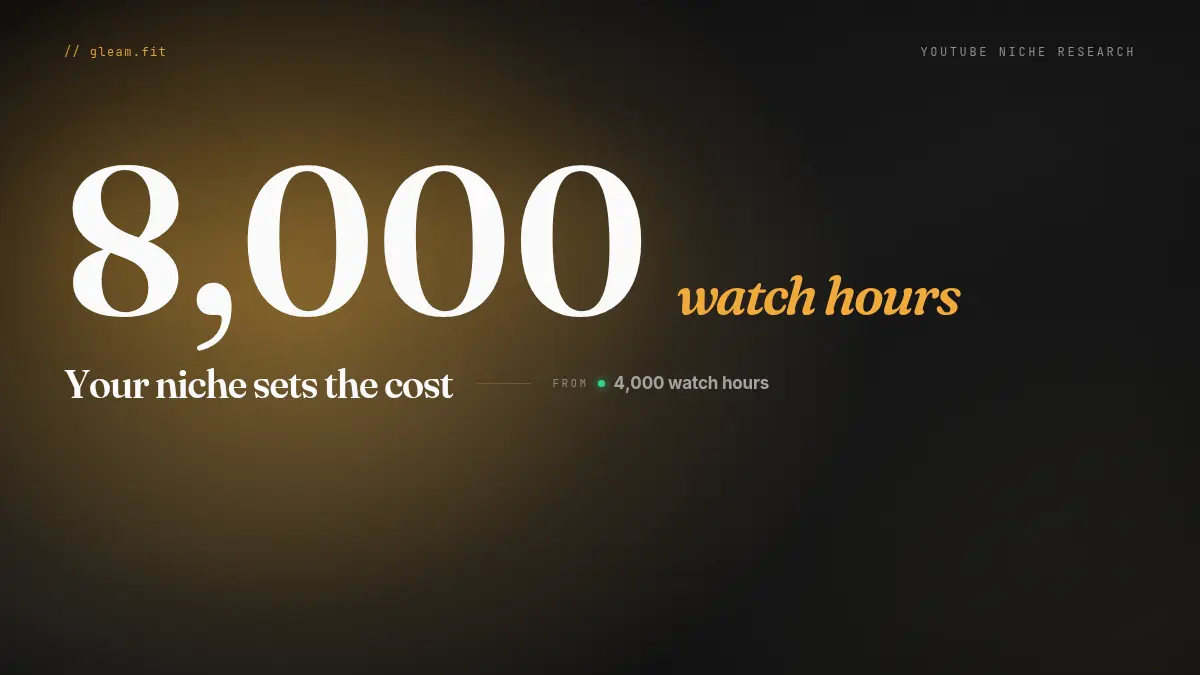
YouTube's 8,000 Watch Hours Rule Is a Niche Math Problem
The YouTube Partner Program bar doubles to 8,000 watch hours on February 1, 2027. That is 480,000 minutes, and the views it takes to produce them depend on your niche's format length — a 4x spread between short- and long-format niches.
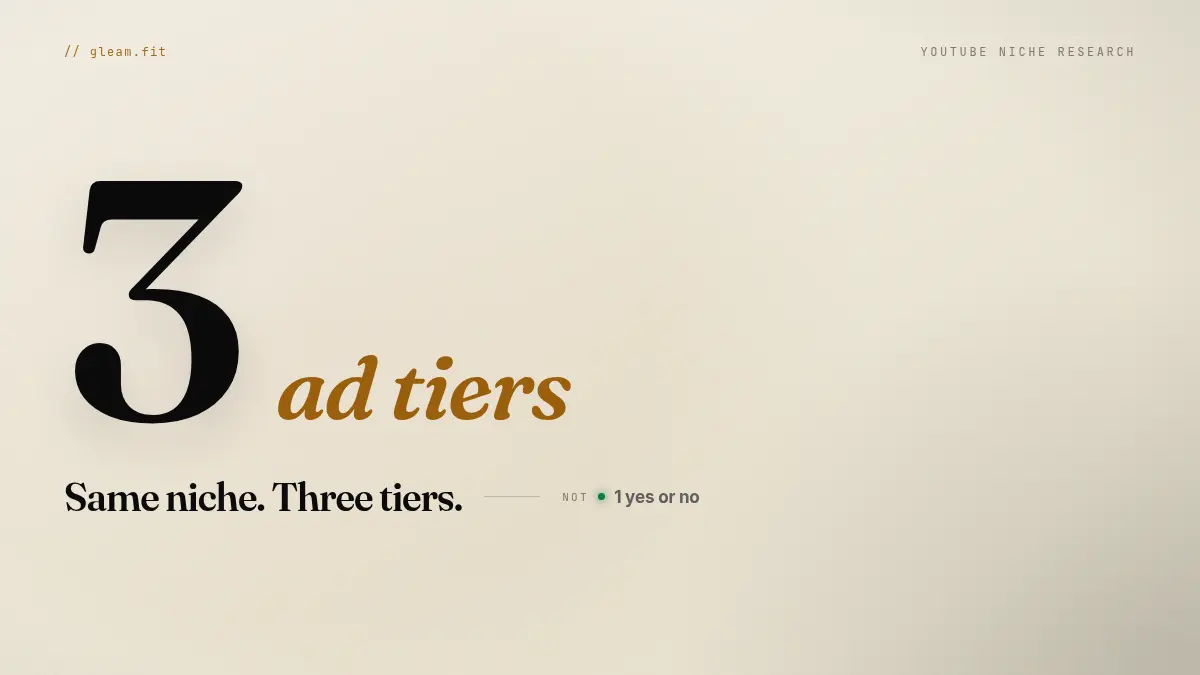
Which YouTube Niches Get Limited Ads — and What Moves Them Up
YouTube sorts the same niche into three ad-revenue tiers, not a yes or no. Which niche archetypes sit on two rungs at once, which lever moves them up, and the one line that no framing fixes.
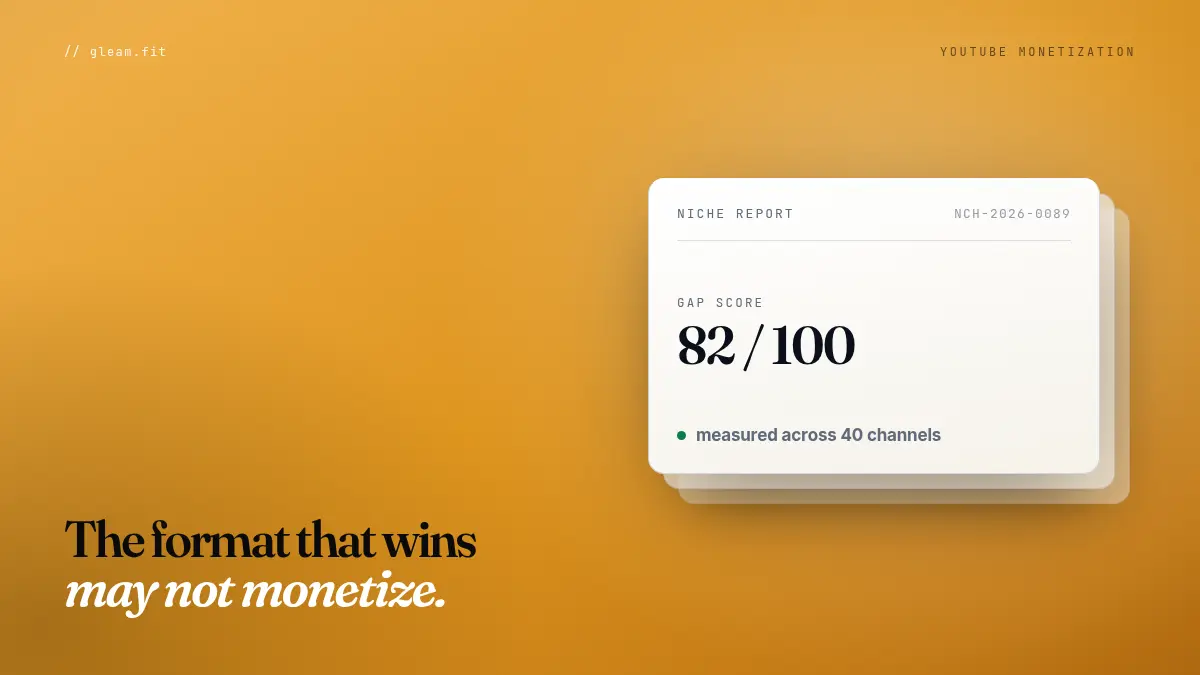
Some YouTube Niches Reward Formats YouTube Won't Monetize
YouTube just named three content types it won't monetize — templated, off-putting, and fake-AI-expert. The catch for new creators: that risk is set the day you pick a niche. Here's how to score a niche's format exposure before you commit.