Shorts vs Long-Form: What YouTube Actually Documents
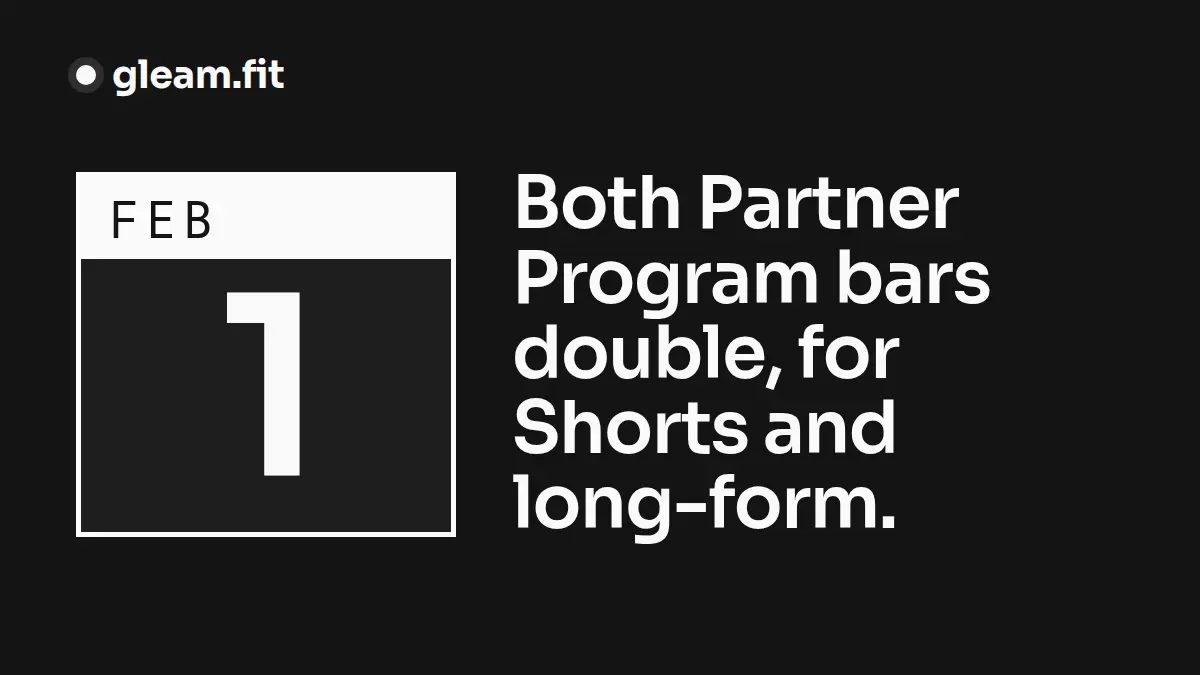
The claim that YouTube Shorts and long-form now run on two separate algorithms is not in any YouTube document. YouTube's recommendation page describes one system and says it scores each video on its own data. The split that is documented is monetization: Shorts and long-form are two different doors into the YouTube Partner Program, and on February 1, 2027 both doors get twice as heavy. If you are choosing a niche and deciding how much of it to shoot vertical, that second split is the one with published numbers behind it.
Did YouTube split Shorts and long-form into separate algorithms?
No YouTube source says so. YouTube's page on how the recommendation system works describes a single system built on two signal groups — "Viewer Personalization" and "Content Performance" — and never names a separate engine for Shorts. The widely repeated "late 2025 decoupling" traces back to third-party analyses, including one by a niche-research tool vendor, not to YouTube.
What that page does say is narrower and more useful: "The algorithm uses fresh performance data for each individual video, rather than relying on past results." That sentence is why a weak upload does not sentence your next one. It is a per-video statement, not a Shorts-versus-long-form statement, and it applied before 2025 as well.
The scale of Shorts is real and sourced. In his January 21, 2026 letter, YouTube CEO Neal Mohan wrote that Shorts "now averages 200 billion daily views." That is the published figure. Growth comparisons against an earlier year circulate widely without a YouTube page behind them, so treat the 200 billion as the number you can cite and the percentage increase as something you cannot.
Can posting Shorts hurt your long-form views?
The honest answer has two halves, and the popular version only reports the first. Per video, YouTube says performance is judged on fresh data for that video. But the same page adds a second sentence that almost never gets quoted: "frequently sharing content that doesn't resonate, can, over time, affect your channel's overall performance."
So "post Shorts freely, they cannot touch your long-form" overstates what YouTube published. A handful of Shorts that land is not a risk. A steady stream of Shorts that viewers skip is the exact pattern that sentence describes. For a creator deciding whether to bolt a daily Shorts habit onto a 15-video channel, that distinction changes the plan: the question is not how many Shorts but whether the ones you post resonate.
The related myth is the reverse direction — that Shorts subscribers arrive and then drag down long-form because they skip it. There is no YouTube documentation for a subscriber-quality penalty. What YouTube does publish is the per-video framing above, plus a note in its watch time guidance that "Relative watch time is more important for short videos and absolute watch time is more important for longer videos." Different lengths are scored on different measures. That is a measurement fact you can plan around, and it is not the same as two engines.
Which Shorts numbers does YouTube actually publish?
Advice posts name swipe-through rate, loop rate, and shares as the three Shorts metrics to chase. YouTube's own Shorts analytics page names a different set: Views, Likes, Subscribers, "Shown in feed" — "The number of times that your Shorts showed in the Shorts Feed" — and "How many chose to view," which "highlights the percentage of times that viewers viewed your Shorts versus swiped away."
Loop rate is not on that page. Neither is a metric called swipe-through rate. "How many chose to view" is the closest published equivalent, and it measures the first decision only, not rewatches. Chasing a number Studio does not report means tuning against an estimate of an estimate.
The same page carries one instruction that resolves most of the confusion above: "Compare videos of the same type." Your channel-wide average view duration will fall when you mix formats. That is arithmetic, not a penalty.
| What you will read | What YouTube publishes | What to measure instead |
|---|---|---|
| "Shorts and long-form run on separate algorithms since late 2025" | One recommendation system, two signal groups; no separate engine named | Per-video performance, not a per-format theory |
| "Shorts can never hurt your long-form" | "frequently sharing content that doesn't resonate, can, over time, affect your channel's overall performance" | Share of your Shorts that clear your own median "How many chose to view" |
| "Track swipe-through rate and loop rate" | Views, Likes, Subscribers, Shown in feed, How many chose to view | Shown in feed against How many chose to view, Short by Short |
| "A tight 8-minute video beats a padded 15-minute one" | "We want both short and long videos to succeed" — relative watch time matters more for short videos, absolute for longer | Your own length band's retention, not a universal target |
| "The formats are independent, so treat them as two channels" | The documented separation is in Partner Program eligibility paths | Which YPP door your niche can actually reach |
Where is the Shorts and long-form split actually documented?
In monetization. YouTube's eligibility page lists two separate routes into the Partner Program today: "Get 1,000 subscribers with 4,000 qualified watch hours in the last 12 months, or Get 1,000 subscribers with 10 million qualified Shorts views in the last 90 days." One channel, two doors, and you only need one of them.
Both doors change on February 1, 2027. YouTube's page on the changes sets new entry thresholds of "8,000 qualified watch hours in the last 365 days, or 20M qualified Shorts views in the last 90 days, in addition to still needing 1k subscribers," and the August 10, 2026 announcement carries the same numbers. Separately, earning from the Shorts Creator Pool will require maintaining "10M qualified Shorts views over the last 90 days." If you are already in the program, "your status is not impacted by this update."
| Door | Today | From February 1, 2027 |
|---|---|---|
| Long-form watch hours | 1,000 subs + 4,000 hours / 365 days | 1,000 subs + 8,000 hours / 365 days |
| Shorts views | 1,000 subs + 10M views / 90 days | 1,000 subs + 20M views / 90 days |
| Shorts revenue share | Included with YPP | Maintain 10M Shorts views / 90 days |
| Already in YPP | — | Status not impacted |
Read the two doors as a niche decision rather than a format preference. Twenty million Shorts views in a rolling 90-day window is roughly 222,000 views a day, sustained. Eight thousand watch hours over 365 days is a different shape of problem, and how many views it costs depends on the average view duration your niche produces — we worked that arithmetic out by duration band in the 8,000-hour niche math.
How should this change the niche you pick?
Three concrete changes, all of them upstream of your first upload.
First, stop picking a format to satisfy an algorithm theory and pick the door your niche can reach. A niche where viewers stay eight minutes reaches 8,000 hours on about 60,000 views. A niche built on 40-second explainers needs the Shorts door, and that door now asks for 20 million views in 90 days. Those are not the same bet, and the gap between them doubles in February 2027.
Second, judge Shorts by whether they resonate, not by volume. The published risk is "frequently sharing content that doesn't resonate," so posting more Shorts is not a free option. Set a floor on "How many chose to view" and stop publishing Shorts that sit under your own median.
Third, treat any dated algorithm claim without a YouTube link as unverified. We have had to correct the same pattern in our own posts on satisfaction versus watch time and on what YouTube publishes about new channels. The tell is always the same: a specific date, a confident mechanism, and no first-party page behind it.
The part of this that research tools help with is the first one. Before you commit a year to a niche, the numbers that decide which YPP door is reachable are demand, competition, and the view duration the niche's format produces. gleam scores those signals across a niche's channels so the choice is made on data rather than a guess — it picks nothing for you, and it does not promise the door will open. If you want to see where a niche sits before you commit, start with the low-competition screen or try it on your own niche.
Ready to find your next video idea?
Gleam helps you discover content gaps and outlier videos with real YouTube data.
Start Free TrialRelated Articles
YouTube Shorts Disable: Why Niche Channels Stay Safe
YouTube now lets users disable Shorts entirely. Here's why funnel-strategy channels lose viewers and niche long-form channels barely notice.
YouTube CTV: Why Niche Channels Win the Living Room
44%+ of US YouTube watch time now happens on connected TV. The living room rewards niche channels with episodic structure over broad feeds.
YouTube Content Shelf Life: Why Your Niche Decides Longevity
Your niche determines whether a video works for 14 days or 2 years. Content shelf life is the growth axis most creators miss.