How to Research a YouTube Niche in 4 Reads
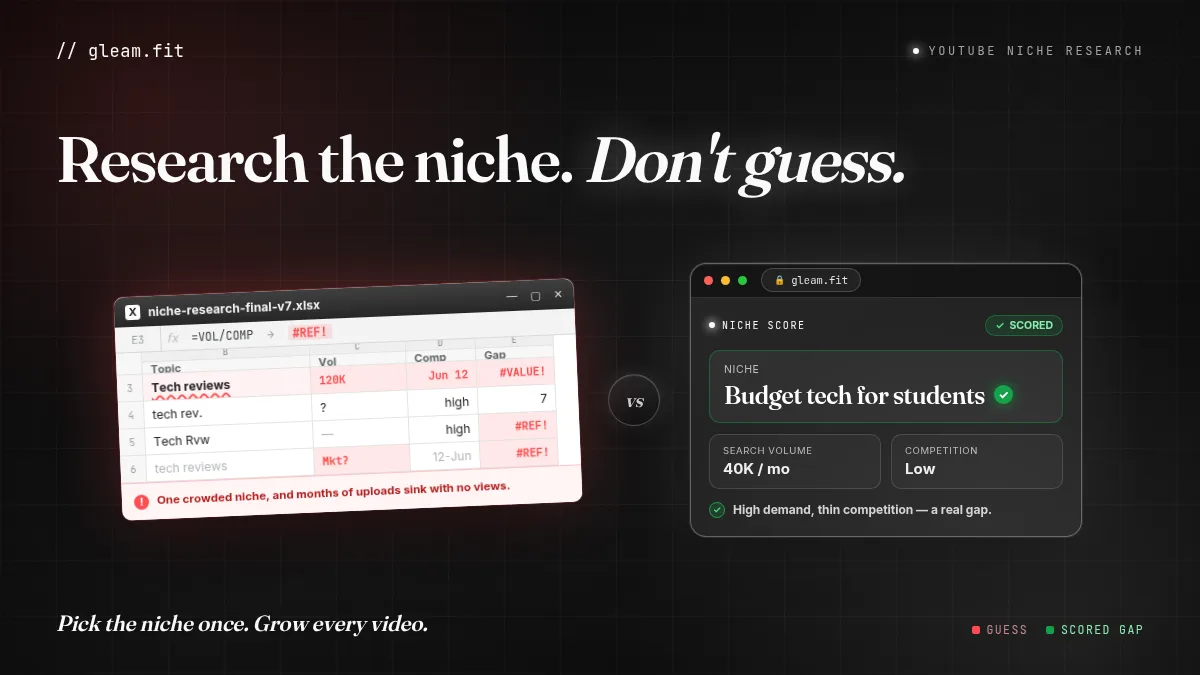
The short answer: Researching a YouTube niche is not one check, it is four reads done in order — demand, competition structure, reachability, and revenue fit. Most creators read demand (search volume) and stop. That single read is why a niche can look promising and still bury a small channel for months. Read all four before you commit, and the picture changes.
I build gleam, a niche research tool for creators, so I spend a lot of time looking at why a niche that "felt" right turns into six months of uploads with no traction. The pattern is almost always the same: the niche had demand, so the creator committed, and never read the three signals that decide whether a small channel can actually win there.
What does it mean to actually research a niche?
It means reading four things about a niche before you film, not after. Demand tells you if anyone is searching. Competition structure tells you who already owns those searches. Reachability tells you whether a new video spreads past your subscriber base. Revenue fit tells you if the niche pays enough to be worth the effort. Skip any one and you are guessing on that dimension.
The order matters because each read can veto the niche regardless of the others. Strong demand with three mega-channels owning every result is a trap. Thin competition in a niche nobody searches is a different trap. Reading them as a sequence — and letting any read disqualify the niche — is the method.
Read 1 — Is there demand, and is it growing or fading?
Demand is whether real people are searching for this topic, and whether that interest is rising or sinking. Search volume alone is a snapshot; direction is the part creators miss. A niche with flat demand and a niche with climbing demand can look identical in a volume number and behave completely differently a year in.
In gleam, the Demand signal is not raw volume. It blends search autosuggest depth, Google Trends interest plus momentum, and result volume — weighted so that autosuggest and trend direction carry most of the signal and raw volume is deliberately discounted. That is on purpose: volume is the easiest number to chase and the weakest predictor of whether a small channel can grow. If you only learn one thing here, learn that a bigger search number is not a bigger opportunity.
Read 2 — Who already owns the search results?
Competition is not the number of videos in a niche — it is who holds the top results and how concentrated they are. Two niches with the same video count can be wide open or completely locked, depending on whether a handful of large channels absorb every spot. That structure, not the raw count, decides how hard it is for a new channel to surface.
gleam reads this two ways: a median-based Competition level (Low, Medium, High) that uses the median channel size so one giant channel does not skew the read, and a unique-channel count that shows how many distinct channels actually own the results. Few unique channels means a few players dominate. Many unique channels of moderate size usually means room. If the results are owned by a small club, the answer is rarely "avoid" — it is often "narrow," which is its own method (run by too few channels? and finding a subniche).
Read 3 — Will a small channel's video actually spread?
Reachability is whether a video in this niche travels past the creator's own subscribers, or only reaches people who already follow them. Some niches reward small channels with views far above their subscriber count; others keep everything locked inside existing audiences. This is the read that separates a niche you can grow in from one where only incumbents move.
gleam shows this through per-video reach (a video's views divided by its channel's subscriber count) and through outlier tiers — videos performing at roughly 2x, 5x, or 10x their channel's own average. When small, independent channels in a niche regularly post videos that out-reach their subscriber base, that is structural evidence the niche lets newcomers spread. One such video is luck; the same pattern across several unrelated channels is a signal. (More on estimating reachable audience.)
Read 4 — Does the niche pay enough for the effort?
Revenue fit is whether the money a niche can realistically earn justifies the work it takes to win there. A niche can have demand, open competition, and good reach, and still be a poor choice if its category pays so little that even strong growth never adds up. This read does not have to be precise — it has to be honest about order of magnitude.
gleam estimates CPM by category so you can weigh a niche's pay band against its difficulty, rather than discovering it after a year of uploads. The point is not to chase the highest-paying category — high-CPM niches often backfire for small channels because the audience you can actually reach is smaller. The point is to make sure pay is in the picture before you commit, not after.
Why does the order of these reads matter?
Because each read is a gate, and reading them out of order is how creators commit to the wrong niche. Demand first tells you the niche is alive. Competition structure can then veto it. Reachability can veto a niche that survived competition. Revenue fit is the last gate. Stop at read one — the most common mistake — and you commit to a niche on the single weakest signal.
This is also why a niche's timing and its saturation are not separate questions you tack on — they fall out of reads two and three. A niche that is "early" usually shows it in low competition concentration plus fresh-content gaps. A niche that is "gold-rushed" shows it in high median competition and few unique channels owning the top.
What gleam does and does not tell you
gleam combines these reads into a single Content Gap Score (built from a niche's freshness gap, quality gap, and demand signal) so you can compare candidates on one number — then drill into the individual reads behind it. That is the honest scope of the tool: it surfaces the data behind each of the four reads from real YouTube search results.
What it does not do, and I would rather say it plainly: gleam does not predict an exact reachable audience headcount, it does not forecast a subscriber-conversion percentage, and it does not show your channel's CTR — those depend on private Studio data and on your execution. It is a commit-time read of a niche's structure, not a guarantee of success. The method is the value; the tool just makes the four reads fast.
Frequently asked questions
Is keyword research the same as niche research?
No. Keyword research usually answers read one — is there demand. Niche research is all four reads. A keyword can have high search volume and still sit in a niche owned by a few large channels with low reachability, which keyword volume alone never shows.
How long does researching a niche take?
Reading demand, competition structure, reachability, and revenue fit for one niche takes a few minutes once you know what to look for. The slow part is doing it honestly for several candidate niches before committing, instead of committing to the first one with demand.
Can I research a niche after I have already started?
Yes, and it is worth doing if a channel has stalled. The same four reads explain why a niche is not growing — usually competition structure or reachability, the two reads that get skipped — and whether to narrow into a subniche or move.
Want the four reads in one place? gleam pulls demand, competition structure, reachability, and CPM fit from live YouTube data for any niche you type. Find your niche → gleam.fit
Written by the gleam team. gleam is a YouTube niche research tool; the product behaviors described here were checked against the live app. Industry figures, where used, are directional and attributed, not first-party YouTube data.
Ready to find your next video idea?
Gleam helps you discover content gaps and outlier videos with real YouTube data.
Start Free TrialRelated Articles
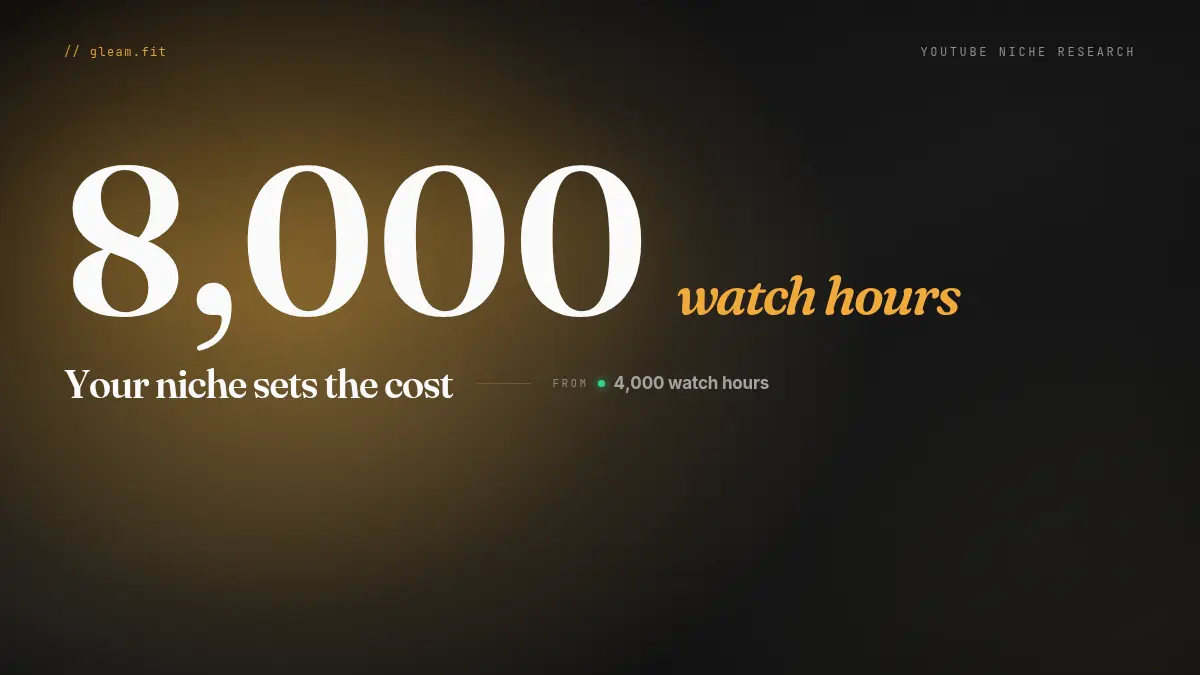
YouTube's 8,000 Watch Hours Rule Is a Niche Math Problem
The YouTube Partner Program bar doubles to 8,000 watch hours on February 1, 2027. That is 480,000 minutes, and the views it takes to produce them depend on your niche's format length — a 4x spread between short- and long-format niches.
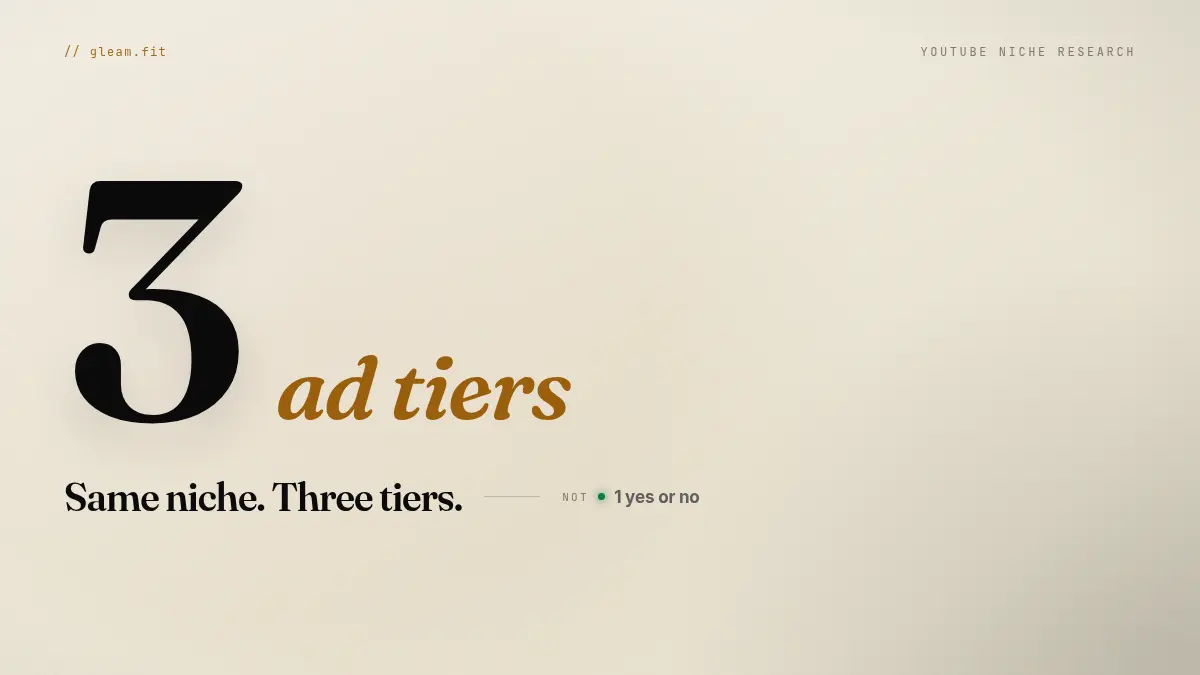
Which YouTube Niches Get Limited Ads — and What Moves Them Up
YouTube sorts the same niche into three ad-revenue tiers, not a yes or no. Which niche archetypes sit on two rungs at once, which lever moves them up, and the one line that no framing fixes.
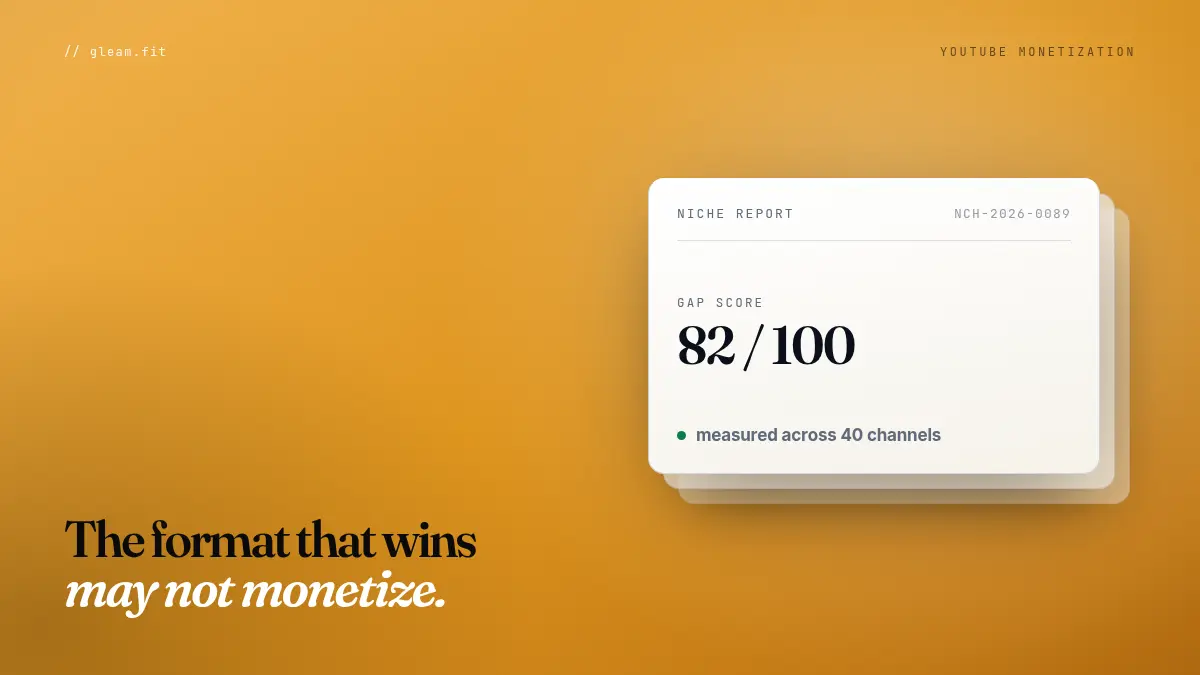
Some YouTube Niches Reward Formats YouTube Won't Monetize
YouTube just named three content types it won't monetize — templated, off-putting, and fake-AI-expert. The catch for new creators: that risk is set the day you pick a niche. Here's how to score a niche's format exposure before you commit.