YouTube CPM by Niche: How to Read a Niche's Pay Ceiling Before You Commit
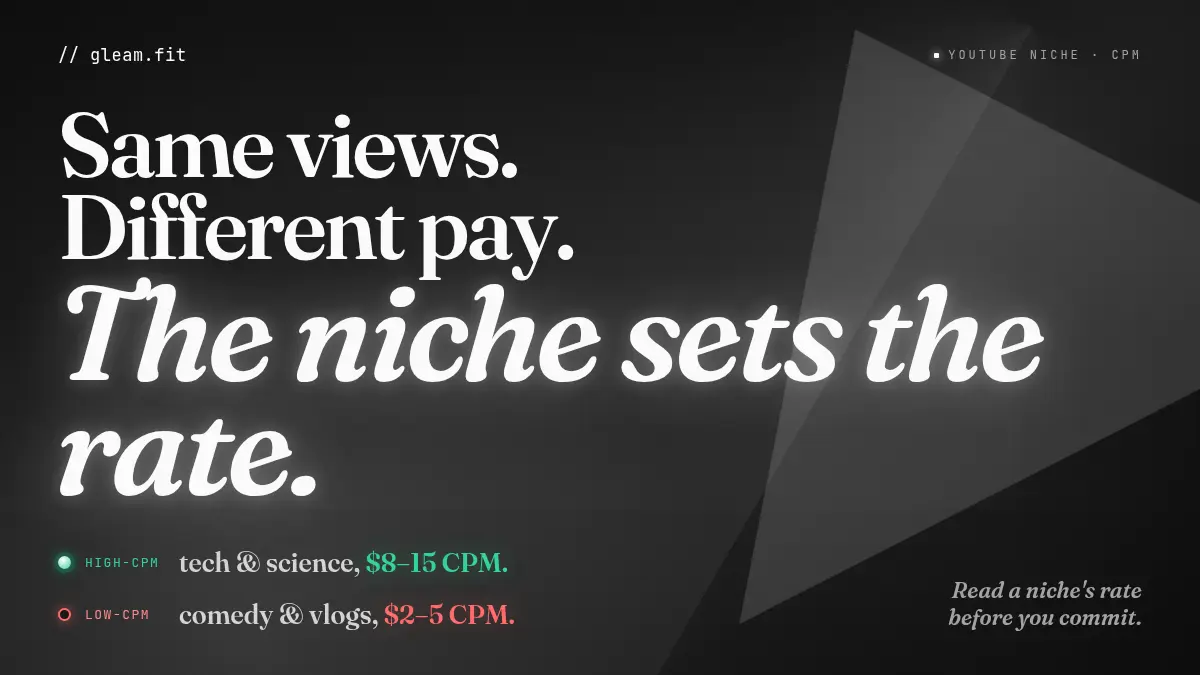
If you pick a YouTube niche off what you enjoy filming, you choose your pay rate without ever seeing it. A finance channel and a comedy channel can pull the same views and bank very different money, because the niche — not the view count — sets the ad rate. Advertisers bid more to put an ad in front of viewers who are about to spend money (investing, software, courses) and far less for passive entertainment. That bid becomes your CPM, and it is mostly locked the day you choose the category. The move is not to chase the highest-paying niche. It is to read a niche's CPM band before you commit, right next to its demand and competition, so you are not 80 videos deep before you learn it tops out near $2 per thousand views.
Why do two YouTube niches with the same views earn different money?
Because pay is set by who is watching, not how many. CPM is what an advertiser pays for 1,000 ad impressions, and advertisers bid against each other for a slice of attention. A viewer researching a $300 phone or a brokerage account is worth more to a bidder than a viewer watching a prank compilation, so the auction clears higher. Your niche decides which auction your views land in.
This is why "get more views" is only half of an income plan. A gaming channel and a personal-finance channel can both hit 100,000 monthly views, and the finance channel can out-earn the gaming channel by 3x on ads alone — same effort, same view count, different niche economics. The view count is your volume knob. The niche is your price knob, and most creators only ever touch the volume knob.
What actually sets a niche's CPM band?
Three forces, and only one is fully in your control before you commit. First and biggest: advertiser intent — how close the audience is to a purchase. Buying-decision niches (finance, business, tech, software, real estate) sit high because the ad can pay for itself in one conversion. Second: audience geography, since ad budgets in the US, UK, Canada, and Australia clear higher than most other markets. Third: season, with Q4 spiking as advertisers spend holiday budgets.
You cannot pick your viewers' country or the calendar month. You can pick the category. That is the lever: the niche you commit to draws a CPM band around your channel before your first upload, and the buying-intent of the topic is what moves it most.
Which YouTube niches sit high vs low on CPM?
Here is the band gleam uses when it scores a niche, aggregated from industry data and creator reports across the main YouTube categories. Treat these as ranges, not promises — an individual channel lands anywhere inside its band depending on audience and ad demand.
| Niche / category | Estimated CPM band (USD) |
|---|---|
| Finance, investing, business, insurance | $8–15+ |
| Science & technology | $8–15 |
| Education | $5–12 |
| How-to & style | $4–10 |
| Gaming, music | $3–8 |
| Entertainment, news, sports, travel, people & blogs | $3–7 |
| Comedy, vlogs, pets & animals, film & animation, autos | $2–5 |
The pattern is the whole point: the gap between the top band and the bottom band is roughly 3x to 5x. Two niches you might weigh on instinct — say a pet channel and a budget-tech channel — can be one rung apart in passion and three rungs apart in pay. The finance and business keyword override exists because those topics consistently clear the high end regardless of which category YouTube files them under.
Is CPM the number that lands in your account?
No, and confusing the two is how creators overestimate a niche. CPM is the advertiser's cost per 1,000 ad impressions. RPM is your revenue per 1,000 views after YouTube takes its standard Partner Program share (creators keep 55% of video ad revenue) and after the fact that not every view is shown an ad. So your RPM runs well below the headline CPM — often roughly half or less once the cut and ad coverage are accounted for.
When you compare niches, compare them on the same basis. A $10 CPM niche does not put $10 per thousand views in your account; it puts something closer to $4–5, before you factor in the views that never served an ad. The bands above are CPM bands — your take-home is a fraction of them, but the ranking between niches holds.
How do you read a niche's pay ceiling before you commit?
Run a niche through three checks before you film a single video. This is the difference between choosing a niche and discovering its economics a year too late.
- Does the CPM band clear your goal at a view count you can realistically hit? Multiply a sober monthly view estimate by the CPM band, divide by 1,000, then roughly halve it for RPM. If the realistic ceiling does not cover the goal, the niche is wrong for that goal — no thumbnail fixes that.
- Does the audience actually buy? Ask what an advertiser would sell to this viewer. If the honest answer is "not much," you are in a low-CPM band no matter how big the niche feels.
- If the band is low, is there a second income path? Some low-CPM niches carry huge, loyal audiences that monetize through sponsorships, affiliates, or your own product instead of ads. Decide that on purpose, not by accident.
A worked example. You are weighing a gaming niche ($3–8 CPM) against a personal-finance niche ($8–15 CPM). You can realistically reach 100,000 views a month in gaming. That is 100 × $3–8 = $300–$800 on a CPM basis, or roughly $150–$400 actually banked after the cut and ad coverage. The finance niche, even at a third of the volume — 30,000 views a month — runs 30 × $8–15 = $240–$450, or roughly $120–$250 banked. Comparable money on one-third of the views, because the niche priced each view higher. Now you are choosing with the price knob visible, not just the volume knob.
What if the niche you love sits in a low band?
A low CPM is not a veto — it is information. Plenty of creators build strong businesses in $2–5 niches by deciding upfront that ads are the smallest revenue line, then leaning on sponsorships, affiliates, memberships, and products. The mistake is not picking a low-CPM niche; it is picking one and assuming ad revenue alone will carry it. If the topic you love sits low, plan the second revenue path from day one rather than hoping the band moves — it will not. We cover those paths in how low-CPM niches got a second revenue path in 2026.
And if you want to stay in a broad, low-paying field but reach a higher-intent slice of it, narrowing helps: a sub-niche aimed at buyers (for example, budget tech "for students" or "for small business") can pull a better band than the generic parent. That is the move in finding a sub-niche inside a saturated niche.
Where the CPM band fits in the rest of the decision
CPM is one axis, not the whole call. A high band on a niche you cannot realistically reach is worth nothing, which is why pay sits next to demand, competition, and how far your videos can travel — see why a bigger niche can have a smaller reachable audience. The point of reading the CPM band before you commit is to stop the most expensive YouTube mistake: spending a year of uploads to find out the niche was never going to pay, when a 30-second check would have told you.
This is the read I built gleam to make instant. When it analyzes a niche, it tags it with an estimated CPM range from the niche's dominant category — so the pay ceiling sits right beside the demand and competition signals, before you commit. It estimates the ad CPM band, not your personal RPM, country mix, or non-ad income — those depend on your channel — but it puts the price knob on screen next to the volume knob, where the decision actually gets made. Read your niche's CPM band → gleam.fit.
Ready to find your next video idea?
Gleam helps you discover content gaps and outlier videos with real YouTube data.
Start Free TrialRelated Articles
YouTube's 8,000 Watch Hours Rule Is a Niche Math Problem
The YouTube Partner Program bar doubles to 8,000 watch hours on February 1, 2027. That is 480,000 minutes, and the views it takes to produce them depend on your niche's format length — a 4x spread between short- and long-format niches.
Which YouTube Niches Get Limited Ads — and What Moves Them Up
YouTube sorts the same niche into three ad-revenue tiers, not a yes or no. Which niche archetypes sit on two rungs at once, which lever moves them up, and the one line that no framing fixes.
Some YouTube Niches Reward Formats YouTube Won't Monetize
YouTube just named three content types it won't monetize — templated, off-putting, and fake-AI-expert. The catch for new creators: that risk is set the day you pick a niche. Here's how to score a niche's format exposure before you commit.