Which YouTube Niches Get Limited Ads — and What Moves Them Up
A YouTube niche is not monetizable or unmonetizable. YouTube sorts the same subject matter into three ad-revenue states — full ad revenue, limited ad earnings, no ad earnings — and the state is decided by how you depict the thing, not by what the thing is. A history channel covering the same battle can land in any of the three. Settle that before you upload 30 videos, because one of the three is a floor no editing decision reaches.
The sorting rules are published. YouTube's advertiser-friendly content guidelines list them category by category, with named examples on each rung. And in August 2026 YouTube updated the Violent Content section specifically to clarify the monetization status of depictions of death in educational, documentary, or news reporting content — the exact seam where sensitive-subject niches live.
Is a YouTube niche either monetizable or not?
No. Every video is sorted into one of three states YouTube names directly in the guidelines: "This content can earn ad revenue," "This content will receive limited ad earnings," and "This content will receive no ad earnings." The niche does not pick the state. The depiction does, and the same niche appears on more than one rung.
War and conflict is the clearest case. Non-graphic educational coverage or discussion of war earns full ad revenue. So do dead bodies that are "fully obscured, blurred, prepared for burial, or shown in historical events like wars, as part of an educational video." Move three bullets down and "real, non-graphic raw footage of armed conflict (such as war) without educational context" sits in limited ad earnings. Same war, same footage grade, different rung — the educational framing is the whole difference.
Which niches sit in more than one ad tier at once?
At least six archetypes appear on two rungs within the same guideline: history and war, true crime, wildlife, hunting, gaming, and fight content. Each is listed by depiction rather than by topic, so a niche shows up as green in one bullet and yellow a paragraph later. This table is the pre-commit read.
| Niche archetype | Full ad revenue when… | Limited ad earnings when… |
|---|---|---|
| History / war | "Non-graphic educational coverage or discussion of war and/or conflict"; bodies "fully obscured, blurred, prepared for burial, or shown in historical events like wars, as part of an educational video" | "Dead bodies with obvious injury or damage in educational or documentary settings (such as a history learning channel)"; raw armed-conflict footage with no educational context |
| True crime | Coverage of tragedies involving one or more deaths "with limited or no display of violent acts or their results" | "Reporting of tragedies involving multiple casualties which include graphic or gruesome details" — including "a documentary on a recent homicide featuring descriptive language of the circumstances of death" |
| Wildlife | "Non-graphic depictions of animal violence in the natural world," where "some blood may be visible fleetingly, but is not the focal subject of the content" | Graphic animal injuries when "focal, prolonged" and "the focal subject of a video" |
| Hunting | "the moment of kill or injury is indiscernible, and with no focal footage of how this dead animal is processed for trophy or food purposes" | "Hunting content featuring fleeting graphic imagery such as injured or suffering animals" |
| Gaming | Graphic scenes "outside the first 15 seconds of the video" | "Graphic game violence in the thumbnail or in the first 8 to 15 seconds of the video" |
| Fight content | "Combat sports such as boxing conducted in a professional setting (such as in a fitness center or arena)" | "Street fights featuring visible injury or knockouts in an educational context" |
Read the right-hand column as the niche's default, not its worst case. Most channels in these spaces drift there without deciding to, because the graphic beat is the easiest thing to reach for in an edit.
What actually moves a video up one rung?
Four levers repeat across every category in the guidelines: context (educational, documentary, or journalistic framing), focus (fleeting versus focal), graphic detail (obscured or non-graphic versus visible injury), and placement (where in the runtime the graphic moment lands).
Placement is the one creators underrate, and it is the only lever with hard numbers attached. In gaming, graphic violence outside the first 15 seconds earns full ad revenue. The same clip in the thumbnail or the first 8 to 15 seconds drops to limited ad earnings. In the thumbnail or the first seven seconds, it earns nothing. One clip, three revenue outcomes, decided by a timestamp. If your niche's convention is a cold-open highlight reel, that convention is a monetization decision you have already made.
Focus does similar work in wildlife. Blood visible in passing during a predator sequence keeps you on the top rung; the same blood held as the subject of the shot drops you a rung. The guideline language is explicit that fleeting and focal are different things.
The lever creators miss most often is that narration counts as depiction. "Description of graphic details of tragedies" sits in the limited tier on its own, and the named example is a documentary on a recent homicide "featuring descriptive language of the circumstances of death." A true-crime channel using nothing but stock B-roll and a voiceover can reach limited ad earnings without showing a single frame of anything. Editing the footage will not fix a script problem.
Which YouTube niches have a ceiling you cannot edit around?
One line removes the context lever entirely: "Direct display of the moment of death involving extreme physical suffering or catastrophic physical trauma (such as executions or human torture), regardless of context." Those last three words end the negotiation. No educational framing, no documentary label, and no journalistic intent moves that content back onto a paying rung.
The no-ads tier also absorbs anything where the graphic element is the point: "Focus on blood, guts, gore, bodily fluids (human or animal), crime scenes or accident photos with little to no context," and "graphic dead bodies in a non-educational video."
That gives you a blunt pre-commit test. Take the most-viewed video in the niche you are considering and mentally delete its graphic beat. If a video someone would still search for remains, the niche has a green path and the table above tells you the framing rule. If nothing is left — if the graphic element is the promise — then limited or no ad earnings is the niche's structural ceiling, and production quality will not raise it. That is a different kind of niche decision from the ones covered in finding a low-competition niche, and it is worth making first.
What did YouTube change in August 2026?
YouTube's ad guideline update log carries one entry for August 2026: "We are updating our Violent Content guidelines to clarify the monetization status of depictions of death within educational, documentary, or news reporting content." It is a clarification of how the existing rules are applied. No new restriction was announced, and treating it as one would be reading more into it than the notice says.
The clarification matters at the niche-selection stage for a narrow reason: the categories being clarified are exactly the ones where the educational or documentary framing was carrying the monetization outcome. When the framing is what stands between the top rung and the middle one, knowing precisely where the line falls is the difference between a niche that pays and one that pays partially. This is the same class of pre-commit exposure as the format risk that makes some niches unmonetizable, arriving from the subject-matter side instead of the production side.
How do you check ad tiers before you commit to a niche?
Five steps, run once per candidate niche, before any filming. Every one of them reads public information about videos that already exist, so the check costs you nothing but the sitting.
- Pull the five most-viewed videos in the niche. Not the top channel's five — five across different channels, so you are reading the niche's convention rather than one creator's habit.
- Name the graphic element in each. Write it down as a noun: visible injury, moment of death, focal blood, graphic narration. If you cannot name one in any of the five, the niche is already on the top rung and you are done.
- Check the first 15 seconds and the thumbnail separately. These are scored on their own clocks in the gaming rules and are the cheapest thing to change.
- Ask whether the video's promise survives removing the element. Yes means you have a green path and a framing rule to hold. No means the ceiling is structural.
- Re-run your revenue math on the lower rung. If the niche only works at full ad revenue, it does not work, because one flagged upload changes the arithmetic.
Step five is where most sensitive-subject niches actually fail, and it is the step people skip. A niche whose CPM ceiling already sits low has no room to absorb a rung drop. A niche with a high rate and a structural yellow tier may still beat it. Neither number means anything alone, which is why creators who plan around a second revenue path are less exposed to this whole category of surprise.
Where this fits in a niche decision
Ad tier is a constraint, not a verdict. It tells you which framing keeps a niche on the paying rung — it says nothing about whether that framing has an audience. "War documentary explainer" and "war footage archive" are different search spaces with different demand and different competition, and the framing rule above pushes you toward one of them before you have checked either.
That check is the next one to run: whether the safer framing still has demand you can reach and competition you can beat. gleam scores demand, median competition, and outlier signals for a niche so that comparison happens before the uploads, not after 30 of them. The ad tier decides which version of the niche you are allowed to build; the numbers decide whether that version is worth building.
Ready to find your next video idea?
Gleam helps you discover content gaps and outlier videos with real YouTube data.
Start Free TrialRelated Articles
YouTube's 8,000 Watch Hours Rule Is a Niche Math Problem
The YouTube Partner Program bar doubles to 8,000 watch hours on February 1, 2027. That is 480,000 minutes, and the views it takes to produce them depend on your niche's format length — a 4x spread between short- and long-format niches.
Some YouTube Niches Reward Formats YouTube Won't Monetize
YouTube just named three content types it won't monetize — templated, off-putting, and fake-AI-expert. The catch for new creators: that risk is set the day you pick a niche. Here's how to score a niche's format exposure before you commit.
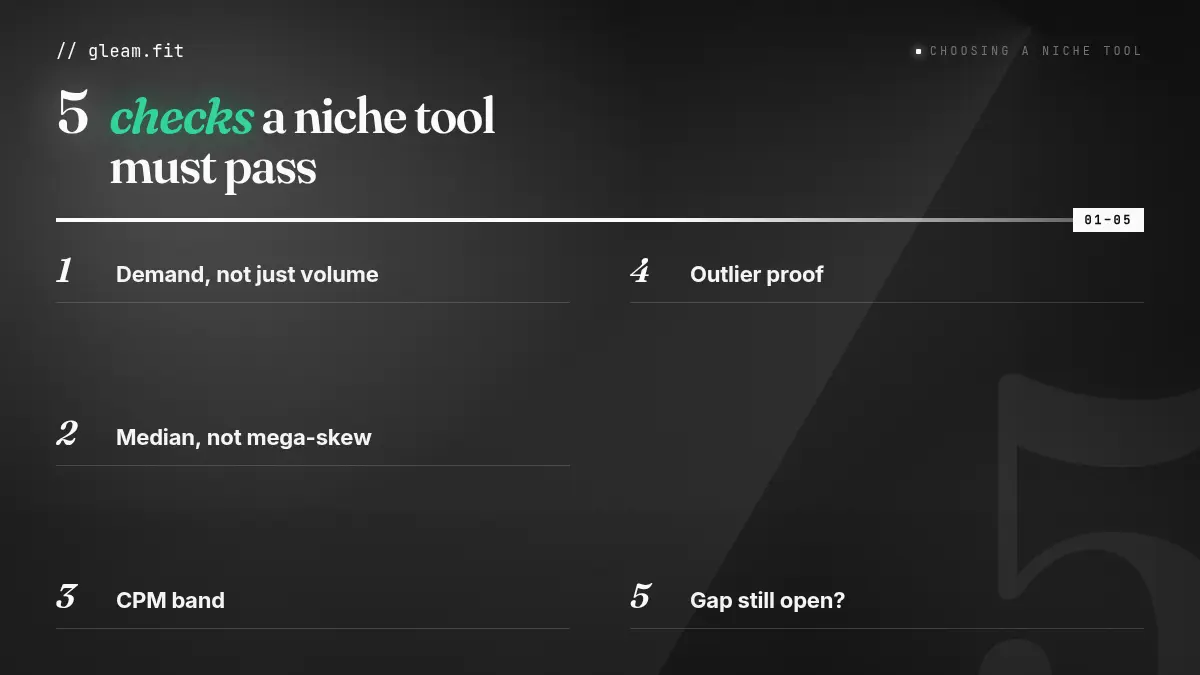
YouTube Niche Research Tools: 5 Checks Before You Pay
Before you pay for a YouTube niche research tool, run it against the five checks that actually decide a niche: real demand, median competition, CPM, outlier proof, and freshness.