Niche vs Keyword: The Difference That Decides Your Growth

You did the keyword research. Found a low-competition term. Optimized the title, tags, and description. Hit publish.
The video got a few hundred views. Maybe a thousand. Then it flatlined.
You did it again. Same process. Same result. 50 videos in, your channel has views but barely any subscribers. The views come and go, but nobody sticks around.
Here's the short answer for a creator still choosing what to build: a keyword decides who clicks one video, a niche decides who comes back for the next one, and YouTube's own documentation says its systems judge each video by the audience it gets shown to — not by a score attached to your channel. That distinction changes what you do on Monday morning, and most advice on this topic gets it backwards.
What's the actual difference between a niche and a keyword?
A keyword is a search term. It's what someone types into YouTube's search bar. "How to cook steak." "Best budget camera 2026." "Beginner yoga routine." Each keyword represents one question from one viewer at one moment.
A niche is a repeatable audience. It's a group of people who share an ongoing interest and will watch multiple videos on related topics. "Cast iron cooking for small kitchens." "Camera gear for solo filmmakers under $500." "Yoga for desk workers." Each niche represents a viewer who comes back.
The distinction matters because they operate at different levels of your channel:
A keyword is video-level strategy. It helps one video get discovered through search.
A niche is audience-level strategy. It decides which viewers YouTube has evidence to show your next upload to.
You need both. But most creators stop at keywords and wonder why their channel doesn't grow.
Does YouTube score your channel or your videos?
Your videos. This is the part the standard advice gets wrong, and it is worth getting right before you rebuild your channel around it.
YouTube's performance FAQ states it directly: "Our systems rely more on video and audience-level signals to decide which videos are the best recommendations for your audience." The same page names what actually drags a channel down — "What can lead to a decline in overall channel views is when viewers stop watching most of your videos when they're recommended to them" — and then tells creators the opposite of what niche advice usually tells them: "It's important that you always keep experimenting with new topics and formats." You can read both sentences in YouTube's own performance FAQ.
The signal list backs this up. YouTube's page on how recommendations work names the primary inputs: watch history, search history, channel subscriptions, likes, dislikes, "Not interested" selections, "Don't recommend channel" selections, and satisfaction surveys. Two of those eight are channel-shaped — subscriptions and the channel-level block. The other six describe a viewer and how they responded to a specific video.
So there is no hidden channel grade being computed while you sleep. What exists is a record of which viewers watched your videos and what they did afterward. That record is the thing a niche builds.
Why do keyword-only channels stop growing?
When your channel targets unrelated keywords — "how to edit video" one week, "best side hustles" the next, "morning routine tips" after that — each video might rank in search. But the viewers who find Video 1 have no reason to watch Video 2. Your subscriber count barely moves because there's no thread connecting your content.
Read that through the mechanism above and it stops being mystical. Every upload is shown to some slice of viewers first. If those viewers were assembled by a different keyword each time, the response data never accumulates into anything: each video starts from a cold audience, earns its own small verdict, and teaches the system nothing that helps the next one. A niche is what makes video number 30 start from video number 29's audience instead of from zero.
This also explains why "never change topics" is bad advice while "pick an audience" is good advice. YouTube tells you to keep experimenting with formats. What it warns about is videos that get recommended and then don't get watched. A new format aimed at the same audience is an experiment. A new topic aimed at strangers is a new channel with your old name on it.
The satisfaction signals in that list are why raw view counts mislead here. A video that collects clicks from a keyword and disappointment from the viewer feeds the system a worse story than a smaller video that lands.
What does the 2027 Partner Program change cost your niche?
Something new landed on August 10, 2026 that turns this from a growth argument into a dated one. On February 1, 2027, the bar to join the YouTube Partner Program doubles. New applicants will need 1,000 subscribers plus either 8,000 qualified public watch hours in the last 365 days, or 20 million qualified Shorts views in the last 90 days. Today's equivalents are 4,000 watch hours and 10 million Shorts views, both published in YouTube's eligibility documentation. Creators already in the program are not affected. The announcement is on YouTube's official blog.
Here is why that belongs in a niche-versus-keyword article. Watch hours are views multiplied by how long people stay, and how long people stay is a property of the niche you picked, not of your effort. Eight thousand hours is 480,000 minutes. A niche where viewers watch two minutes charges you 240,000 views for that. A niche where they watch twelve charges 40,000. Same rule, six times the work, decided before your first upload. We ran that arithmetic across formats in the 8,000 watch hours breakdown.
Keyword research cannot see any of this. Search volume tells you how many people ask a question. It does not tell you how long they stay for the answer, whether they return, or what the niche pays once you qualify. Those are the numbers that decide whether the channel is worth a year.
How do you tell a niche from a keyword before you commit?
Keyword research is still necessary. It's step two. Step one is naming the audience you intend to serve repeatedly. Four checks separate the two:
Reach test: "Can this search term drive views to one video?" If yes, it's a keyword.
Depth test: "Can I make 50 videos for the same audience without repeating myself?" If yes, it's a niche.
Return test: "Would someone who watches Video 1 also want Videos 2 through 10?" If no, you have traffic, not an audience.
Evidence test: "After 10 uploads, would the response data describe one group of viewers or ten unrelated ones?" One group is a niche.
Run a candidate through this table before you commit a year to it:
| Question | Answered by keyword research | Answered by niche research |
|---|---|---|
| How many people search this? | Yes | — |
| How long do they watch? | No | Yes |
| Will they watch a second video? | No | Yes |
| How many views buys 8,000 watch hours here? | No | Yes |
| Who already owns this audience? | Partly | Yes |
| What does a view earn? | No | Yes |
A practical approach: start with a specific audience, then use keyword research to find the questions that audience is asking. Not the other way around.
Don't start with the keyword "how to edit video." Start with the audience: "solo YouTube creators who edit on a laptop." Then find their keywords: "best free editing software for beginners," "how to color grade without plugins," "editing workflow for weekly uploads." Each video targets a different keyword. Every video speaks to the same viewer. That is what niche research produces and a keyword tool does not.
Quick check: niche or keyword?
"How to lose weight" → keyword
"Home workouts for busy parents over 40" → niche
"Best laptop 2026" → keyword
"Tech gear for remote freelancers under $300" → niche
"How to start a YouTube channel" → keyword
"YouTube growth strategy for faceless channels" → niche
The keyword gets a click. The niche gets a second view from the same person.
The bottom line
Keywords and niches aren't opposites. They work together. But the order matters.
Niche first. Keywords second.
Define the audience you want to serve consistently. Then use keyword research to find the specific topics that audience is searching for. The reason isn't that YouTube grades your channel — its documentation says the opposite. It's that a niche is the only way the response data from one video is worth anything to the next one, and from February 2027 it is also what sets the price of getting paid at all.
Gleam scores a niche on demand, competition and outlier gaps from real YouTube data, so you can compare two candidates before you spend the year rather than after. Start with the difference between niche and keyword research, then run your shortlist.
Ready to find your next video idea?
Gleam helps you discover content gaps and outlier videos with real YouTube data.
Start Free TrialRelated Articles
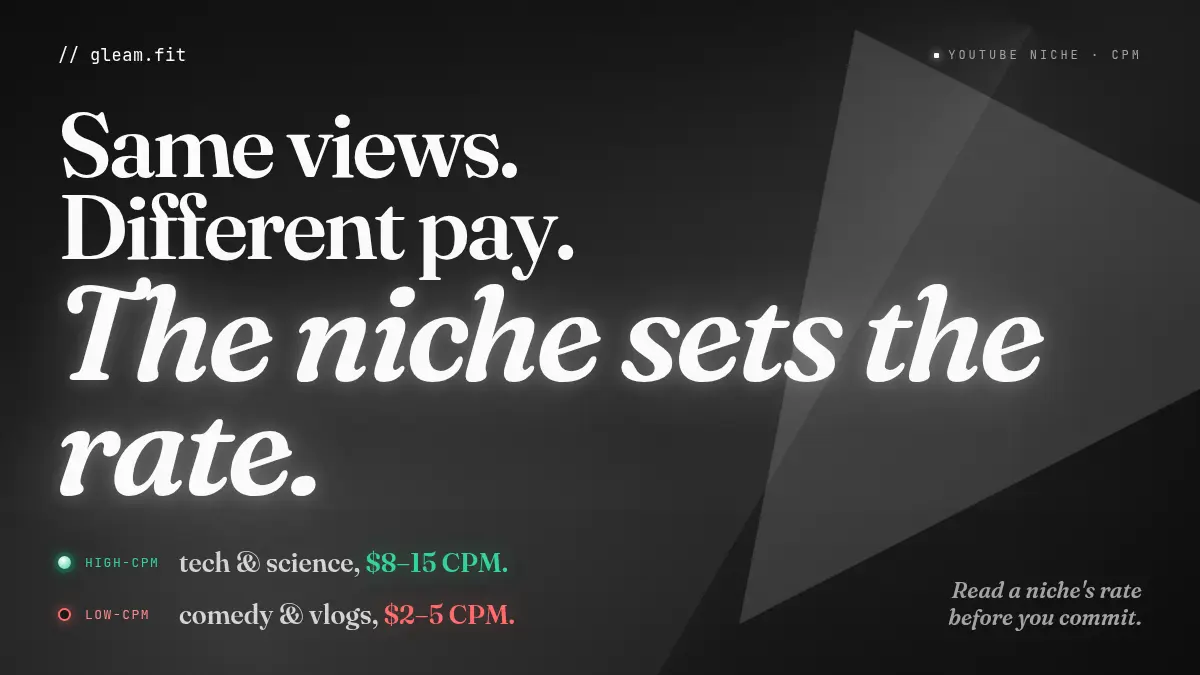
YouTube CPM by Niche: How to Read a Niche's Pay Ceiling Before You Commit
Two YouTube niches with the same views can earn very different money. A niche sets its CPM band the day you pick it — here's how to read that pay ceiling before you commit.
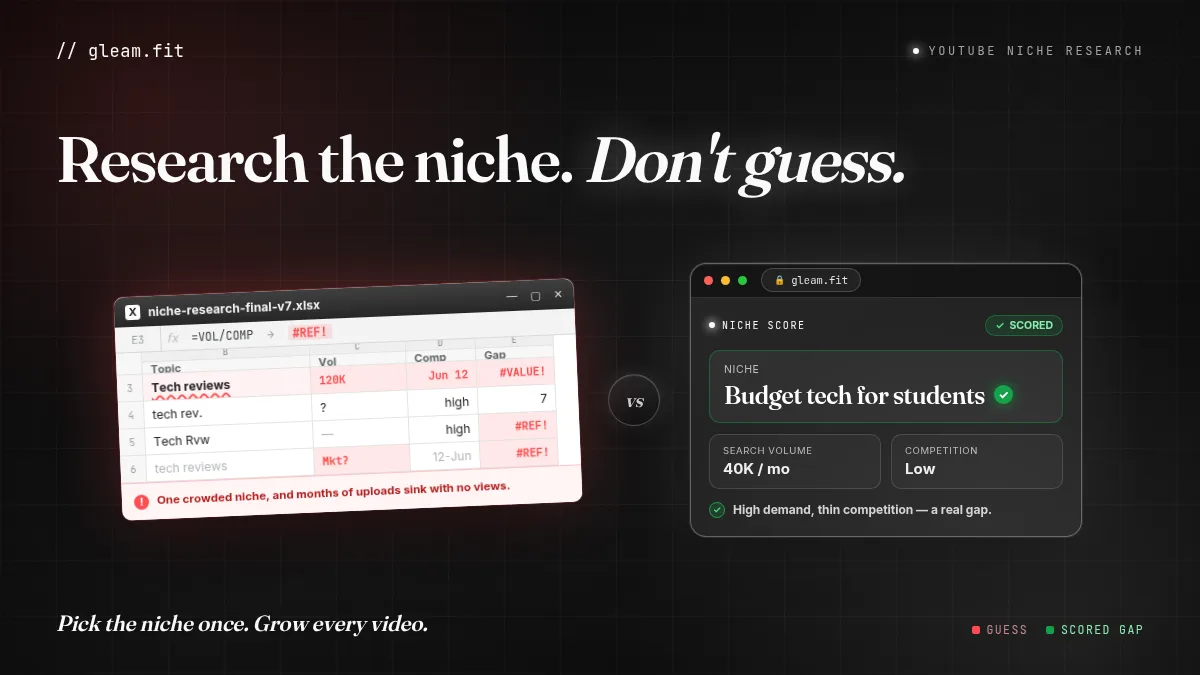
How to Research a YouTube Niche in 4 Reads
Most creators check search volume and commit. A repeatable four-read method — demand, competition structure, reachability, and revenue fit — to weigh a YouTube niche before you choose it.
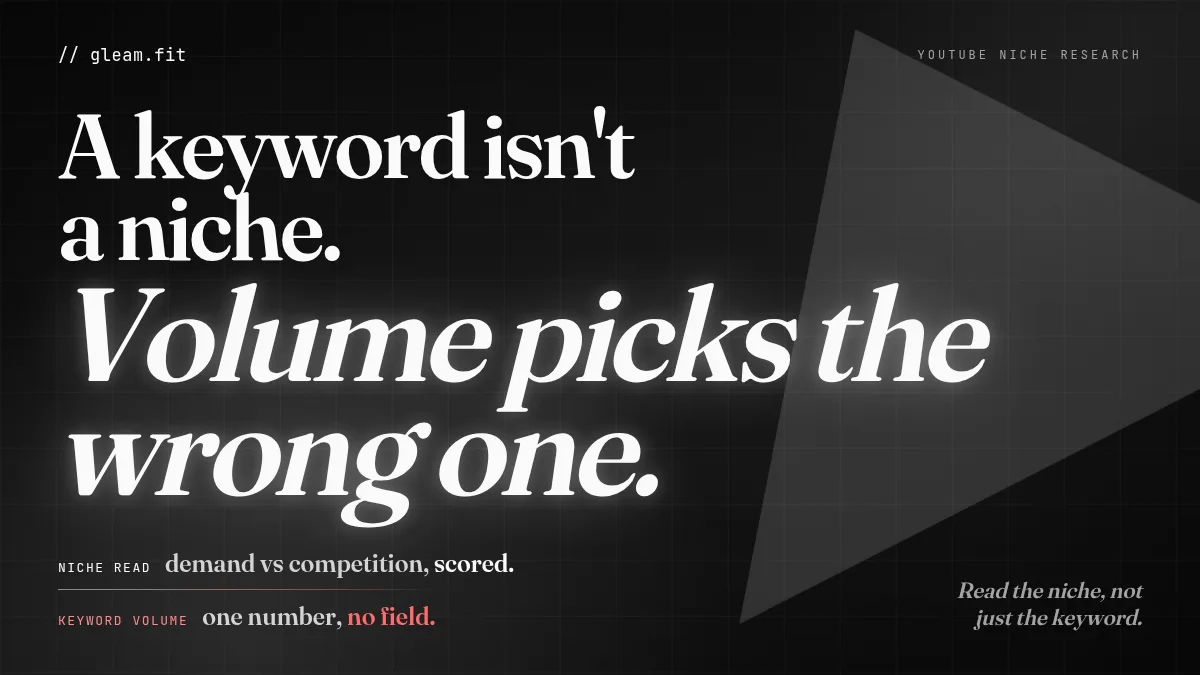
YouTube Niche Research vs Keyword Research: Why Volume Picks the Wrong Channel
A keyword tells you a topic gets searched. It doesn't tell you the niche around it is winnable. Here's the difference, and how to read the field before you commit a channel to it.