How to Research a YouTube Niche Before You Film a Single Video
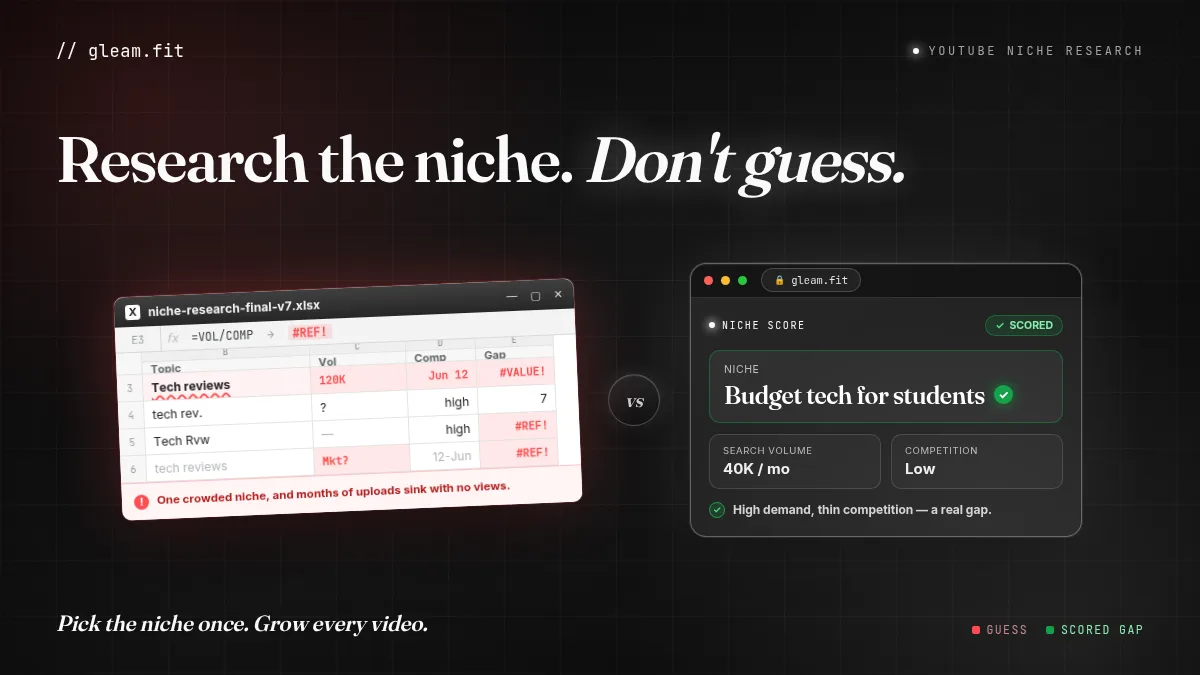
Researching a YouTube niche means reading the field — demand, competition, and reach — from data that already sits on the platform, before you film anything. For a new or small creator picking a niche off gut feel, the payoff is concrete: you kill a dead niche before you upload 30 videos into it. Most guides tell you to test with three to five pilot videos and read the views afterward. That costs months you only get to spend once. This is the pre-upload version — four reads you can run on competitor data in an afternoon, then a go/no-go call you can defend.
I build a niche-research tool, so I read this kind of competitor data every day. The method below is the same one the tool automates, written out so you can run it by hand.
What does researching a YouTube niche actually mean?
It means measuring the supply-and-demand structure of a topic before you commit, not picking the subject you like most. A niche is a market: it has a level of demand, a level of competition, and a ceiling on how far a new video can travel. Research is reading those three numbers from videos that already exist — not auditioning your own.
Passion still matters for staying power. But passion is the input you already know; the field is the part you can be wrong about. A creator who loves a topic that is run by ten 2-million-subscriber channels has not done research — they have made a wish. The reads below tell you whether the wish has a gap to grow into.
Why is filming pilot videos the slowest way to research a niche?
Because a pilot test answers the question after you have already paid for it. Shooting three to five videos and reading the views takes a small creator weeks to months, and a flat result still does not tell you whether the niche is wrong or the execution was. You spend the most expensive resource — time — to learn what competitor data shows for free.
The top guides for this exact search all end on "test with pilot videos and watch the metrics." That advice is not wrong; it is just last. The competitor field is already full of other people's pilot tests — thousands of videos, with views and subscriber counts attached. Reading those first means your own pilots confirm a decision instead of making it.
Step 1 — Read demand as a direction, not a search-volume number
Demand is whether real viewers are actively looking for this topic and whether that interest is rising or fading — not a single "40,000 searches a month" figure. Search volume is one input, and a noisy one: a high number can be one seasonal spike or a term that means three different things. Read the direction first, the magnitude second.
In practice that means three signals: what YouTube's own search box autosuggests when you type the seed (live demand, no quota), the direction of Google Trends over the last year, and the rough volume of results. When my tool combines these into one demand read, search-result volume is weighted at only about 20% of the signal — the autosuggest and trend direction carry the rest, because a big search number does not mean a reachable audience. A niche reading "Trending up" with thin competition is worth more than a bigger niche that is flat and crowded.
Step 2 — Judge competition by the median channel, not the biggest one
Look at the channel sitting in the middle of the top results, because one giant channel distorts every average. If you average subscriber counts, a single 5-million-subscriber outlier makes a wide-open niche look impossible. The median ignores that outlier and tells you what a typical competitor actually looks like.
Concrete thresholds make this a yes/no read. When the median competitor in the top results sits under roughly 50,000 subscribers and under 100,000 views per video, the field is Low competition — a small channel can place. A median above 500,000 subscribers or a million views per video is High: the niche is run by establishments, and you would be entering at the bottom. Everything between is Mid. This is the same median logic behind why a niche run by too few channels is hard to break into.
Step 3 — Count the channels, and check if videos travel past subscribers
Two cheap reads tell you whether there is room: how many distinct channels hold the top results, and how far the typical video reaches beyond its own subscriber base. A topic where the top 50 results come from eight or more different channels has shared oxygen. One where five channels own everything is concentrated, and a newcomer fights for scraps.
The second read is reach: divide a video's views by its channel's subscriber count. A ratio near 1 means the video mostly reached existing subscribers. A ratio of 2 or more means it traveled — search and suggested feeds pushed it past the subscriber wall, which is exactly how a small channel grows. When several small channels in a niche post videos reaching 5x or 10x their subscriber count, the algorithm is actively distributing that topic to new viewers. If a niche is concentrated, the fix is usually to narrow into a sub-niche rather than walk away.
Step 4 — Sanity-check the money before you commit
Estimate the niche's revenue band from its dominant category, then decide if the math survives a small audience. Ad rates vary widely by topic: industry estimates put Education around $5–12 CPM and Science & Technology near $8–15, while Gaming and Comedy sit closer to $2–8, and finance-adjacent topics push to the top of the range. These are directional estimates from sources like Influencer Marketing Hub and Social Blade, not guarantees — your real RPM depends on country, audience, and ad demand.
The point is not to chase the highest CPM. A high-rate niche with a tiny reachable audience can earn less than a mid-rate niche people actually watch, and high-CPM fields tend to be the most crowded. Pair this read with Step 3: revenue is rate multiplied by reachable views, and the second number is the one a small channel can move. That trade-off is why some niches collect views without ever building a base.
How do you turn the four reads into a go/no-go decision?
Score each read against a threshold and commit only when demand and reach are both present and competition is not establishment-level. One green light is not a niche; the signal is several reads agreeing across different channels. Here is the worksheet I run before committing to any topic:
| Read | Green (go) | Red (rethink or narrow) |
|---|---|---|
| Demand direction | Trending up or stable, real autosuggest pull | Declining, or volume is one seasonal spike |
| Competition (median) | Median under ~50K subs / ~100K views | Median over 500K subs or 1M views |
| Channel concentration | 8+ distinct channels in the top results | 5 or fewer channels own everything |
| Reach (views ÷ subs) | Small channels hitting 2x–10x their subs | Videos stuck near 1x — no travel |
| CPM band fits the plan | Rate × a reachable audience clears your goal | High rate but a tiny, crowded field |
Three or more greens, with at least one being demand and one being reach, is a niche worth filming into. A field that is all red is not a failure of your idea — it is months you just saved. When the picture is mixed, that is the signal to check saturation more closely or narrow the angle before you record. To run these reads on live YouTube data instead of by hand, that is what gleam is built for — it pulls the competitor field and scores demand, competition, channel count, and reach in one pass, so the call is data, not a guess.
None of this predicts a hit. A scored niche is a field with room, not a promise of views — execution still decides the rest. What the four reads buy you is the one thing a pilot test cannot: the chance to be wrong on paper, in an afternoon, instead of wrong on camera, over six months.
Ready to find your next video idea?
Gleam helps you discover content gaps and outlier videos with real YouTube data.
Start Free TrialRelated Articles
How to Research a YouTube Niche: A Step-by-Step Process for Small Creators
Niche research for small channels is an elimination process, not brainstorming. Five signals in the order that kills bad niches fastest, with a go/no-go checklist.

How Narrow Should Your YouTube Niche Be?
Niching down helps until demand vanishes. Read demand vs competition before you over-narrow a YouTube niche, with a reusable narrowing scorecard.
How to Research a YouTube Niche in 4 Reads
Most creators check search volume and commit. A repeatable four-read method — demand, competition structure, reachability, and revenue fit — to weigh a YouTube niche before you choose it.