How to Research a YouTube Niche: A Step-by-Step Process for Small Creators
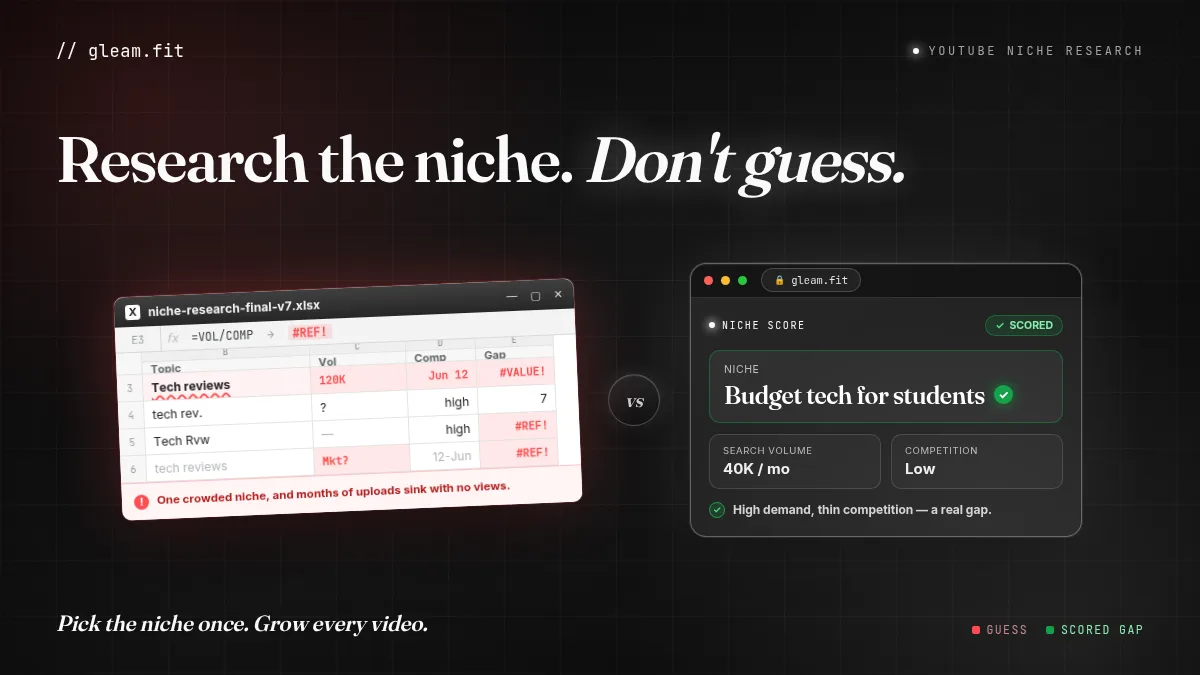
Researching a YouTube niche, for a small channel picking off gut feel, is not brainstorming topics you would enjoy. It is an elimination process. You take one niche idea, run it through five signals in the order that disqualifies bad niches fastest, and you stop the moment one fails. Do this before you film, and you sidestep the most expensive mistake on the platform: 30 uploads into a niche that was never winnable for a channel your size. Below is the exact order I would check, the threshold that kills a niche at each step, and a go/no-go checklist you can copy.
Why is most YouTube niche research backwards?
Most guides start with your passion, then add a loose look at a few competitors. That order burns weeks. A niche you love but that ten large channels already own is still dead for a new channel, so checking passion first tells you nothing about whether you can win.
Look at the guides that rank for this query — invideo, TubeBuddy, OutlierKit, Envato. They run the same loop: pick a passion, check Google Trends, scroll the search bar, eyeball three to five competitors, then "test some video ideas." None of them give you a stop rule. None tell you which signal should knock a niche out first. The fix is to lead with the disqualifiers. Spend your research time only on the niches that survive demand, then competition, then concentration, then reach, then payoff — in that order.
Step 1: Is there real demand, or just a big volume number?
Real demand means people actively search the topic and interest is steady or rising — not one keyword with an impressive volume figure. In gleam, the Demand signal weights YouTube autosuggest at 50%, Google Trends direction at 30%, and raw result volume at only 20%, because volume on its own flatters a niche that is fading.
That 20% cap on volume is deliberate. A keyword can show six figures of monthly searches and still be a niche in decline, where every fresh upload lands on a shrinking audience. gleam labels the direction as Trending up, Stable, or Declining from autosuggest breadth plus Trends momentum. Disqualifier: if demand reads Declining, or autosuggest returns almost nothing, the niche is out — no matter how big the volume number looks. If demand is real but you are unsure whether you are early or late, read the timing signals in early vs. gold-rushed niches before you go further.
Step 2: Is the competition winnable for a small channel?
Winnable competition is not about how many videos exist — it is about the median channel behind the top results. gleam reads competition from the median subscriber and view count of the ranking videos, not the single loudest channel, so one 5M-subscriber video does not make a niche look harder than it really is.
The bands are concrete: median under 50K subscribers (and under 100K median views) reads Low, 50K to 500K reads Mid, and above 500K subscribers or a million median views reads High. A High band means the front page is held by established channels, and a channel starting from zero has to outrank them on their own turf. Disqualifier: a High competition band when you are starting cold. For the full method on reading saturation as demand divided by quality supply, see how to check niche saturation before you commit.
Step 3: How few channels actually own the niche?
Even a Low-competition niche can be a trap if three channels own every top result. gleam counts the unique channels across the ranking videos and shows it as an "N channels" badge — fewer unique channels means a tighter ring of incumbents you would have to break into before anyone sees you.
A useful rule of thumb: roughly eight or more unique channels across the top results means there is room for a new entrant, while a handful of channels splitting every slot means the niche is concentration-locked. Median size says how big the incumbents are; the channel count says how few of them there are. Disqualifier: a tiny set of channels dominating the page. If the broad niche is concentrated but the demand is real, do not abandon it — narrow into a layer they ignore, the way I lay out in finding a sub-niche inside a saturated niche and in niches run by too few channels.
Step 4: Do videos in this niche travel past their subscribers?
A niche where videos only reach existing subscribers will not grow a new channel. gleam computes per-video reach as views divided by subscribers — the outperform ratio — and tiers it: 2x or more is Above Average, 5x or more is Strong, 10x or more is Extreme. When small channels in a niche routinely clear 5x, the niche is pushing videos to non-subscribers.
That ratio is the precondition for growth on a young channel, because you have almost no subscriber base to lean on. Look for the pattern across several independent channels, not one lucky video. gleam also scores engagement as likes plus comments weighted three times, divided by views, since a comment is a stronger signal of an audience that sticks. Disqualifier: only mega-channels post videos that travel, while small channels stall near 1x. For how reach sets the ceiling on who you can ever pull in, see estimating a niche's reachable audience and why some niches get views but no subscribers.
Step 5: Is the payoff worth the months it will take?
A winnable, reachable niche still has to pay for the time. gleam estimates a CPM range from the dominant category of the ranking videos — Education $5 to $12, Science and Technology $8 to $15, Gaming $3 to $8, Howto and Style $4 to $10 — and bumps finance and business topics higher. Read that next to reachable audience, never next to raw search volume.
Low CPM is not automatically fatal. A mid-CPM niche with a large, reachable audience often out-earns a high-CPM niche you can barely reach, which is the trap I unpack in why high-CPM niches backfire for small channels. Disqualifier: a low CPM category paired with a small reachable audience, where neither ad revenue nor scale ever shows up. If one of those two is strong, the niche can still pass.
What does the go/no-go checklist look like?
Run a single niche idea down this list in order and stop at the first No. The point is to spend zero further time on a niche the moment it fails a gate, instead of researching all five signals for a niche that was already dead at step one.
- Demand: Is the trend Stable or Trending up, with real autosuggest breadth? If Declining, stop.
- Competition: Is the median competitor in the Low or Mid band? If the median channel is above 500K subscribers, stop.
- Concentration: Are there roughly eight or more unique channels across the top results? If a handful own the page, narrow to a sub-niche or stop.
- Reach: Do small channels here routinely hit 5x or more views-to-subscribers? If only mega-channels travel, stop.
- Payoff: Does the CPM range and reachable audience justify months of uploads? If both are thin, stop.
A niche that survives all five is worth committing to. A niche that fails any one of them is a niche you just saved yourself from learning about the slow way, after 30 videos.
How do I run all five reads in one pass?
You can do every step above by hand in YouTube search, Google Trends, and a spreadsheet — it just takes an afternoon per niche. gleam runs the same five reads from one keyword search on a single screen, so you can compare niches in minutes instead of an afternoon each.
From one search you get a 0 to 100 Gap Score that combines freshness, quality, and demand; the median-based competition band; the unique-channel count; the per-video reach tiers; and a category CPM range. It is a selection tool, not a success guarantee — it surfaces the signals you should read before committing, and the decision stays yours. If you want to skip the afternoon-per-niche math, run your niche idea through all five signals on gleam.fit and read the result against the checklist above.
Frequently asked questions
How long should researching a YouTube niche take?
By hand, budget about an afternoon per niche to pull competitor data, check Trends direction, and tally channel concentration. With the signals scored in one place, a first pass takes a few minutes, which is what makes comparing several niches realistic before you commit to any of them.
Can I skip steps if a niche looks obviously good?
No. The five steps are ordered by what disqualifies a niche fastest, so a niche that looks obviously good on demand can still fail on concentration or reach. Run them in order and stop at the first No — that is the entire time-saving point of the sequence.
Does a high Gap Score guarantee my channel will grow?
No. A high Gap Score flags an opening where demand outruns the quality of current supply, but reach and payoff still decide whether a small channel can capitalize on it. Treat the score as one of five reads, not as a forecast of your results.
Ready to find your next video idea?
Gleam helps you discover content gaps and outlier videos with real YouTube data.
Start Free TrialRelated Articles
How to Research a YouTube Niche Before You Film a Single Video
A pre-upload method to read demand, competition, channel concentration, and reach from competitor data — so you decide before you film, not after months of pilot videos.

How Narrow Should Your YouTube Niche Be?
Niching down helps until demand vanishes. Read demand vs competition before you over-narrow a YouTube niche, with a reusable narrowing scorecard.
How to Research a YouTube Niche in 4 Reads
Most creators check search volume and commit. A repeatable four-read method — demand, competition structure, reachability, and revenue fit — to weigh a YouTube niche before you choose it.