YouTube's View Count Change: What It Does to Niche Research
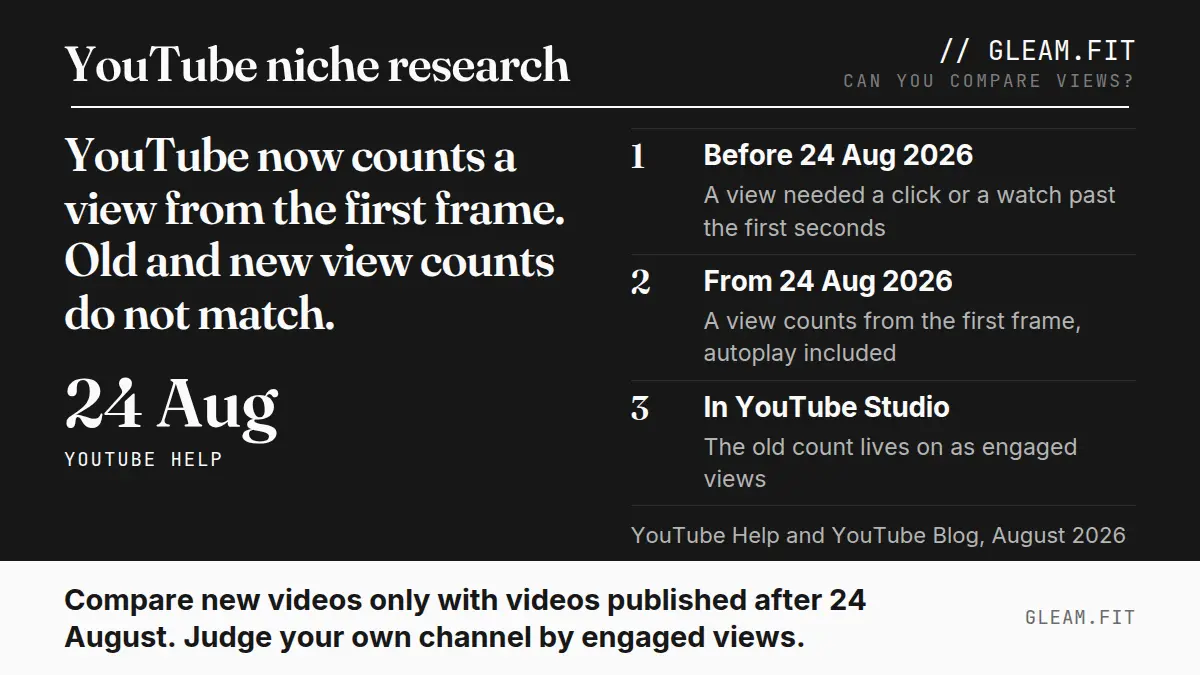
YouTube's view count change took effect on August 24, 2026: a long-form view now counts the moment a video starts to play, including a video autoplaying on the Home page. Before that date, a long-form view needed a click or a watch past the first seconds. YouTube has not announced any restatement of older counts, so every video published before the change now carries a count built from two different rules. If you judge a niche by comparing view counts, outlier ratios, or views per day across videos of different ages, part of what you are measuring is the calendar. The fix for niche research is small: compare videos published after August 24 only with each other, and read the older ones as a separate group.
What exactly changed in how YouTube counts views on August 24, 2026?
The definition of a public view changed for long-form videos and live streams. YouTube's help page on how engagement metrics are counted now opens with: "Beginning August 24, 2026, views are counted the moment a video starts to play across all formats, including Shorts, long-form videos (VOD), and live streams."
The YouTube Blog explainer, published August 19, gives the two definitions side by side. A view "is now defined as counting from the very first frame — whether that's a Short appearing in the feed or a long-form video autoplaying on the Home page." The old rule survives under a new name: "An engaged view is defined as clicking to watch or watching past the initial seconds." The same post says views are counted this way "going forward," and that there is "no change to recommendations — the algorithm."
Shorts are not new to this. Shorts moved to first-frame counting on March 31, 2025, as Emplifi's notes on the update record. What changed in August is that long-form and live now follow the same rule.
Why does the new view count break niche comparisons?
Because niche research compares videos of different ages, and those videos no longer share one definition of a view. A video published in May 2026 collected its first three months of views under the old rule and everything since August 24 under the new one. A video published in September has only ever been counted the new way. YouTube has not announced a restatement of older counts, and Emplifi's advice to its own customers is direct: "comparisons that cross August 24, 2026 mix two different definitions."
Three numbers that niche researchers lean on all have the public view count inside them:
| Signal | How it is built | What the change does to it | What to do instead |
|---|---|---|---|
| Outlier ratio | Views ÷ channel subscribers | A recent video can clear the bar on plays an older video would not have been credited with | Rank outliers only against videos published after August 24 |
| Views per day | Views ÷ days since publish | Recent videos accrue every day under the broader rule; older videos only partly did | Compare velocity inside one publish window, never across the date |
| Engagement rate | (Likes + comments) ÷ views | Likes and comments are unchanged, so a larger view denominator pulls the rate down | Do not read a lower rate on recent videos as a colder audience |
Emplifi's notes list the same third column from the reporting side: "Watch time, likes, comments, shares, subscribers" do not change, while "Engagement rate and similar metrics that use views in the denominator" may look different. The direction is predictable. The size is not. YouTube has not published how many autoplay starts a typical long-form video receives, so there is no honest multiplier to correct old counts with. Treat the date as a boundary, not as a number you can adjust away.
This matters most for the one test that decides many niche calls. Outlier videos are how you check whether a niche rewards newcomers, and the useful outliers are the recent ones. Recent is exactly where the count moved. A September video at 8x its channel's subscribers and a June video at 5x are not a clean 8-versus-5 comparison anymore.
Which niche signals can you still trust after the change?
Anything that does not use the view counter is unaffected, and so is any comparison made entirely inside one side of the date. Subscriber counts, upload counts, video length, publish dates, like and comment counts, and the number of distinct channels ranking for a search all mean what they meant in July.
Relative comparisons also survive if both sides were counted the same way. Two videos published in September can be ranked against each other. So can two channels' post-August uploads. What breaks is ranking a September video against a June video, or reading a channel's view trend straight through late August.
That gives a practical split when you look at a niche's search results:
- Post-change group: videos published on or after August 24, 2026. Fully comparable with each other. This group answers "is the niche rewarding new uploads right now?"
- Pre-change group: everything older. Mixed counts, so use it for structure (who ranks, how long the videos are, how often channels post), not for fine view comparisons.
If the post-change group is small, that is a finding too. It limits how much evidence you have, and how many channels you analyze should grow until you have enough recent videos from different channels to compare.
How should you read your own channel's numbers now?
Use engaged views for anything that crosses August 24. The public counter on your videos will likely step up after the change without your audience changing at all, and Emplifi's notes say the same about the numbers third-party tools show: view counts "may go up after August 24."
The monetization side did not move. YouTube's help page states: "This update won't impact your YouTube Partner Program (YPP) earnings or eligibility. YPP earnings will still be based on 'engaged views' and 'engaged watch hours'. YPP eligibility will still be based on 'qualified views.'" The Blog explainer adds that "the vast majority of analytics remain anchored on engaged views, so the way metrics like CTR, AVD, and retention are calculated hasn't changed." So if you are working toward the 8,000 watch-hour bar that starts in 2027, your progress is measured the old way, and a bigger public counter does not move you closer.
The asymmetry is the problem for research. You can see engaged views for your own channel in YouTube Studio. You cannot see them for anyone else's. Emplifi's notes put it plainly for competitor channels: tools show the "public view counter only (same number as on YouTube)," because "YouTube does not expose Analytics metrics without channel authorization." Every outside read of a niche, whether it comes from a tool or from scrolling search results, runs on the public counter.
What should a pre-commit niche check look like now?
The same checks as before, with one added step at the start. Before you commit to a niche, run it like this:
- Tag every result by publish date. Mark each video in the search results as before or after August 24, 2026.
- Count the post-change group. If it holds only a handful of videos, or most come from one or two channels, widen the search terms before drawing conclusions. The rest of the check depends on this group.
- Find outliers inside the post-change group only. Rank views against each channel's subscribers within that group. A small channel outperforming its size among September videos is still the strongest sign a niche lets newcomers in; see why small channels get outlier views for what to look for next.
- Use the pre-change group for structure. Who ranks, how long the videos run, how often those channels upload. None of that depends on the view counter.
- Do not trend views across the date. If a channel's recent uploads look like a jump, check whether they all sit after August 24 before you call it momentum.
This split fades as time passes. Every month, more of a niche's search results were published after the change, and the post-change group becomes the whole picture. For the next few months, it is the difference between reading a niche and reading a calendar.
gleam reads the same public view counts through YouTube's Data API that every outside tool reads, so its outlier ratio, engagement rate, and the video score built from them move with this change like everyone else's. It does not convert old counts into engaged views, because that data is not public. What it gives you is the publish date on every video card next to views, subscribers, and engagement, plus a Newest sort, which is what the split above needs. Run a niche search, sort by Newest, and find where August 24 falls before you compare anything.
Ready to find your next video idea?
Gleam helps you discover content gaps and outlier videos with real YouTube data.
Start Free TrialRelated Articles
YouTube's 8,000 Watch Hours Rule Is a Niche Math Problem
The YouTube Partner Program bar doubles to 8,000 watch hours on February 1, 2027. That is 480,000 minutes, and the views it takes to produce them depend on your niche's format length — a 4x spread between short- and long-format niches.
Which YouTube Niches Get Limited Ads — and What Moves Them Up
YouTube sorts the same niche into three ad-revenue tiers, not a yes or no. Which niche archetypes sit on two rungs at once, which lever moves them up, and the one line that no framing fixes.
Some YouTube Niches Reward Formats YouTube Won't Monetize
YouTube just named three content types it won't monetize — templated, off-putting, and fake-AI-expert. The catch for new creators: that risk is set the day you pick a niche. Here's how to score a niche's format exposure before you commit.