YouTube's 8,000 Watch Hours Rule Is a Niche Math Problem
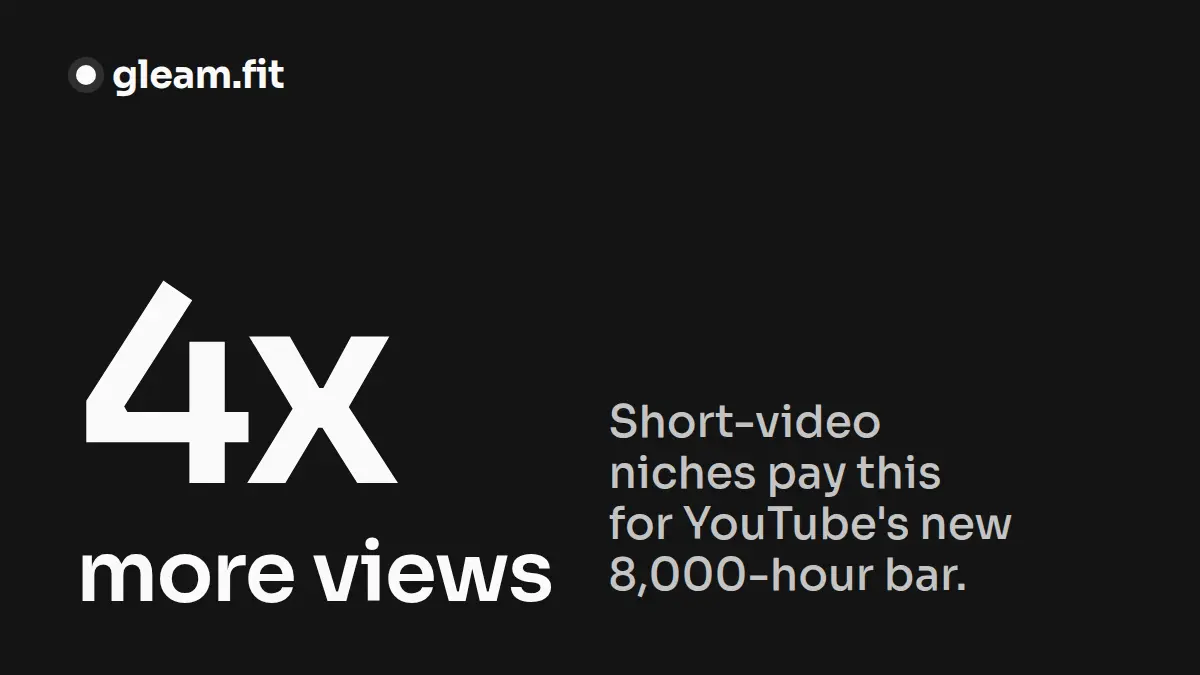
On February 1, 2027, the bar to join the YouTube Partner Program doubles: new channels will need 8,000 watch hours in the last 365 days instead of 4,000. The number everyone is reading as one bar is really a different bar per niche. Eight thousand hours is 480,000 minutes, and the views it takes to produce them depend entirely on how long people watch a video in your niche. A niche whose ranking videos run 12 minutes clears it on roughly 80,000 views. A niche whose ranking videos run 3 minutes needs about 320,000. Same rule, four times the work — and you can estimate which side your niche sits on before you upload anything.
What exactly changes in the YouTube Partner Program on February 1, 2027?
New applicants will need 1,000 subscribers plus either 8,000 qualified public watch hours in the last 365 days, or 20 million qualified Shorts views in the last 90 days. Today those alternatives are 4,000 watch hours and 10 million Shorts views. Both numbers double. Creators already in YPP are not affected.
YouTube announced this in its post on YPP updates for 2027, and calls it the first significant change to eligibility since 2018. The current thresholds it replaces are the ones still published in YouTube's own eligibility documentation: 1,000 subscribers with 4,000 qualified watch hours over 12 months, or 1,000 subscribers with 10 million qualified Shorts views over 90 days.
One more piece lands the same day and is easy to miss. From February 1, 2027, a channel needs 10 million qualified Shorts views over the previous 90 days to be eligible for ad and subscription revenue sharing on Shorts. Fall below it and you stay in YPP, keep earning on long-form, and Shorts revenue sharing resumes once you cross back over.
Why does 8,000 watch hours cost some niches four times more views?
Because watch hours are views multiplied by average view duration, and average view duration is a property of the niche before it is a property of you. Eight thousand hours is 480,000 minutes. Divide that by the minutes a typical viewer actually watches and you get the view count you need. The divisor changes by niche; the 480,000 does not.
| Average view duration | Views needed for 8,000 hours | Views needed under the old 4,000-hour bar |
|---|---|---|
| 1 minute | 480,000 | 240,000 |
| 2 minutes | 240,000 | 120,000 |
| 3 minutes | 160,000 | 80,000 |
| 5 minutes | 96,000 | 48,000 |
| 8 minutes | 60,000 | 30,000 |
| 12 minutes | 40,000 | 20,000 |
| 20 minutes | 24,000 | 12,000 |
Read the first column as the decision, not the outcome. Picking a niche where viewers stay two minutes rather than twelve is a decision to need six times the views for the same monetization date. That was already true at 4,000 hours. Doubling the bar doubles both counts, so the gap in absolute views between a short-format niche and a long-format one doubles with it.
What does 8,000 watch hours look like as a daily number?
About 22 hours of watch time every day, sustained. The window is the last 365 days, so it rolls: hours earned 366 days ago drop out of the count. Divide 8,000 by 365 and the target stops being a milestone you approach and becomes a rate you have to hold. The old bar was 11 hours a day.
Translate that into uploads and the niche difference shows up again. At a 6-minute average view duration, 22 hours a day is 1,315 minutes, or about 219 views a day. At 1.5 minutes it is roughly 877 views a day for the same result. Two niches, the same threshold, a four-fold difference in the daily traffic you have to hold for a year.
The rolling window is why slow accumulation fails quietly. A channel adding 5 hours a day is not 40% of the way to monetization — it is at a ceiling of about 1,800 hours, because hours leave the window at the same rate they enter it. The daily rate, not the running total, is what decides whether the threshold is reachable at all.
How do you estimate a niche's watch-hour cost before you commit?
You cannot see another channel's retention — it is private. You can see every ranking video's duration, and duration sets the ceiling on average view duration, since nobody watches longer than the video runs. That ceiling is coarse but it is public, consistent across niches, and enough to rank candidate niches against each other before a single upload. Five steps:
- Pull the top 20 to 30 videos ranking for the niche's main keywords and record the median duration. Use the median, not the average — one 90-minute documentary will drag an average somewhere useless.
- Halve it for a working average view duration. This is a deliberately rough assumption standing in for retention you cannot measure. Replace it with your real number from YouTube Analytics as soon as you have 30 days of your own data.
- Divide 480,000 by that working figure. A 12-minute median gives 6 minutes and 80,000 views. A 3-minute median gives 1.5 minutes and 320,000 views.
- Divide that by the median views of the same result set to get how many videos performing like the ones already ranking it would take. At 25,000 median views, the 12-minute niche needs 4; the 3-minute niche needs 13.
- Compare it to what you will publish in 12 months. Those ranking videos are the ones that won, so treat the count as a floor, not a forecast. If the floor already exceeds your realistic output, the niche fails the bar at your pace.
Step 5 is where most of the value is, and it is the step people skip. The absolute counts move around with your assumptions. The ratio between two niches barely does — a 4x difference in required views survives being wrong about retention, because the error applies to both sides.
Is the Shorts route still a realistic way in?
Twenty million qualified Shorts views in 90 days works out to about 222,000 views a day, sustained for three straight months. The old bar of 10 million was roughly 111,000 a day. For a channel that has not launched, the Shorts path stops being an easier alternative and becomes the harder one.
This matters most for niches whose format is natively short. If the videos ranking in your niche are 60-second clips, the long-form path charges you 480,000 views and the Shorts path asks for 20 million in a quarter. Neither door is cheap, and choosing that niche means choosing both prices. Shorts and long-form run on separate distribution systems, so strength on one side does not carry across to the other.
The 500-subscriber fan-funding tier is untouched by this announcement and still opens memberships and Super Thanks well before the ad threshold, which is a real advantage for small niche audiences. It is not ad revenue, and it does not move the 8,000-hour line.
What does this change about picking a niche?
It adds a number to the pre-commit checklist that was not there before: how many views this niche charges for 8,000 hours. Demand, competition and CPM were already on that list. Format length now sits beside them, because it sets the exchange rate between the audience you win and the monetization date you reach.
Two niches with identical demand and identical competition are no longer equivalent. The one whose ranking videos run long reaches the threshold on a quarter of the views. That is a pre-commit judgment — after 30 uploads it costs months to undo, which is the whole reason to score a niche with data first. Duration also interacts with how much you have to publish, and the niche sets that pace too.
The retention half of the equation stays the hardest part to estimate from outside, and it varies more by niche than most creators expect. Halving the median duration is a starting assumption, not a measurement. Say so in your own notes, and correct it with your analytics rather than defending it.
gleam runs the search once and returns the two inputs this calculation needs: the duration on every competing video, and a competition read built from the median subscriber and view counts of the result set rather than the average, so one large channel does not distort it. You can filter the results by duration to see what the niche's format actually is. Score a niche before you commit to it — the arithmetic above takes about five minutes once you have the numbers in front of you.
Ready to find your next video idea?
Gleam helps you discover content gaps and outlier videos with real YouTube data.
Start Free TrialRelated Articles
YouTube's View Count Change: What It Does to Niche Research
YouTube now counts a long-form view from the first frame, autoplay included. Videos published before August 24, 2026 carry mixed counts, so niche comparisons need a date split.
Which YouTube Niches Get Limited Ads — and What Moves Them Up
YouTube sorts the same niche into three ad-revenue tiers, not a yes or no. Which niche archetypes sit on two rungs at once, which lever moves them up, and the one line that no framing fixes.

Some YouTube Niches Reward Formats YouTube Won't Monetize
YouTube just named three content types it won't monetize — templated, off-putting, and fake-AI-expert. The catch for new creators: that risk is set the day you pick a niche. Here's how to score a niche's format exposure before you commit.