How to Choose Between Two YouTube Niches When You're Torn
By the Gleam Team — we build niche-research tools for small YouTube creators, so most of this comes from staring at the same demand-and-competition data you're about to.
To choose between two YouTube niches that both look viable, stop comparing how exciting they feel and score them on the same five signals: Gap Score, channel concentration, reachable audience, CPM band, and how long you can keep making videos. The niche with high demand against thin competition wins — and once you line the numbers up, the choice usually stops being close.
Why does gut feeling fail when both niches look good?
Because by the time you're down to two, both have already cleared the obvious bar. You have video ideas for each. Both have an audience. Gut feeling was useful for the first cut — it's useless for the last one, where it just picks whichever niche sounds more fun this week.
The cost of guessing here is the worst kind: it's invisible for months. Two roughly equal-looking niches can have very different ceilings, and you only find out after 30 uploads when one channel stalls and the other would have compounded. Choosing the wrong finalist doesn't feel like a mistake — it feels like "YouTube is hard." This is the exact moment the step-by-step niche research process is built for: turning a feeling into a read you can defend.
What five signals actually decide between two niches?
The generic advice — passion, demand, competition — is fine for finding a niche, but it can't break a tie, because both finalists already pass it. To separate two viable niches, line them up on five harder signals:
- Gap Score — demand measured against the quality of existing supply, on a 0-100 scale. This is the single number that rolls demand, freshness, and competition together, so it's the first column on the scorecard.
- Channel concentration — how many unique channels actually own the top results. A niche run by 6 large channels is far harder for a newcomer than one spread across 20 mid-sized ones, even at the same search volume. (Why too few channels is a warning sign.)
- Reachable audience — not search volume, but how far a single video travels past its own subscriber base. A big niche dominated by giants can have a smaller reachable ceiling than a tighter one. (The bigger-niche, smaller-reach paradox.)
- CPM band — the pay ceiling the niche sets before you film. Same views, very different money. (How to read a niche's pay ceiling.)
- Your sustainable output — the one signal no tool sees. If you can list 50 video ideas for niche A and run dry at 12 for niche B, A wins even on a lower score, because the channel that survives is the one you don't quit.
How do you score each niche side by side?
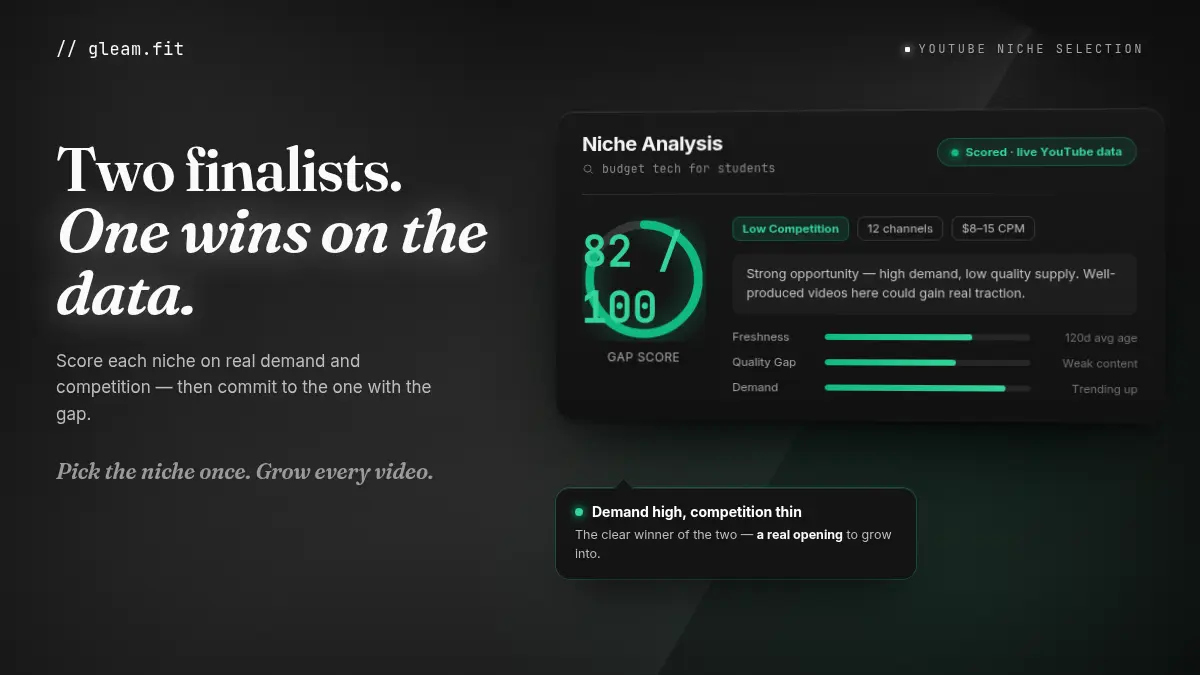
You score them one at a time, then line the results up — there's no magic "compare two niches" button, and you don't need one. Run each niche as its own search in gleam and read four numbers off the same panel: the Gap Score ring (80+ is a great opening, 60+ good, 40+ moderate, under 20 saturated), the Competition badge (Low / Mid / High, based on the median competitor's size, not the giants), the "N channels" badge (fewer means a few creators own it), and the CPM band for the niche's category. The Demand bar tells you the direction — Trending up, Stable, or Declining.
Gleam shows you the signals; it does not print an audience headcount or pick the winner for you. You read the ceiling from the concentration and per-video reach yourself. Drop the numbers into a scorecard so the two niches sit next to each other:
| Signal | Niche A | Niche B | Who wins |
|---|---|---|---|
| Gap Score (0-100) | __ | __ | __ |
| Competition (Low/Mid/High) | __ | __ | __ |
| Unique channels in top results | __ | __ | __ |
| Demand direction | __ | __ | __ |
| CPM band | __ | __ | __ |
| Video ideas you can list right now | __ | __ | __ |
Six rows, two columns. When you can see both niches on one grid instead of holding them in your head, the gut argument quietly loses.
A worked example: cooking for beginners vs meal prep for students
Say you're torn between "easy cooking for beginners" and "meal prep for college students." Both feel viable — there's clearly an audience for each. Here's the kind of read the scorecard surfaces (illustrative numbers, not a forecast):
| Signal | Cooking for beginners | Meal prep for students | Who wins |
|---|---|---|---|
| Gap Score | 41 | 76 | Meal prep |
| Competition | High | Low | Meal prep |
| Unique channels | 5 | 18 | Meal prep |
| Demand direction | Stable | Trending up | Meal prep |
| CPM band | lower | slightly higher | Meal prep |
| Ideas you can list | 40+ | 25 | Cooking |
"Cooking for beginners" looked like the safe, big pick — and that's exactly the trap. It's huge, which is why five massive channels own the top results and the Gap Score sits at 41. "Meal prep for students" is smaller, but it's a specific layer with thinner competition, more independent channels, and rising demand — a real opening. The only column cooking wins is your idea count, and that's the row to take seriously: if you'd genuinely run dry on meal prep at 25 videos, the data tie-break still bends to the niche you can keep feeding.
What's the tiebreaker when the scores are nearly equal?
Treat any Gap Score difference under about 10 points as a tie — the inputs aren't precise enough to split hairs on. When it's that close, break the tie in this order:
- Reachable audience first. Take the niche with more independent channels and smaller dominant players. A new channel needs room to be discovered, and a field of giants doesn't leave any.
- Sustainable output second. Of the remaining options, pick the one you can make 50 videos about without forcing it. Consistency beats a marginally better score.
- CPM last. Only reach for pay rate as a final separator. CPM is a multiplier on views you can actually get — a high rate on a niche you can't reach pays nothing. If you've already started monetizing, the pay-ceiling read matters more.
If both niches score low — say both under 30 — the honest answer is that neither is ready, and the fix isn't to pick the less-bad one. Either widen the angle or drop into a subniche of a saturated space until one of them clears the bar.
Frequently asked questions
Should I just pick the higher-CPM niche?
No. CPM is a multiplier on reachable views, not a substitute for them. A niche with double the CPM but a quarter of the reachable audience pays less. Settle reach and competition first, then let CPM break a close call.
What if both niches score badly?
Don't pick the least-bad one. A low score on both means the angle is too broad or too crowded for a new channel. Check saturation, then narrow into a subniche of whichever space you're more drawn to and re-score.
How long until I know I chose right?
Give the winner a real run — a fixed number of videos, not a fixed number of weeks — before you second-guess it. The point of scoring before you film is that you've already removed the obvious wrong choice, so early flat numbers are a signal to fix packaging, not to switch niches again.
Two niches, one grid, five signals. Score both of your finalists in gleam and commit to the one with the gap — once, so every video after it compounds.
Ready to find your next video idea?
Gleam helps you discover content gaps and outlier videos with real YouTube data.
Start Free TrialRelated Articles
YouTube's 8,000 Watch Hours Rule Is a Niche Math Problem
The YouTube Partner Program bar doubles to 8,000 watch hours on February 1, 2027. That is 480,000 minutes, and the views it takes to produce them depend on your niche's format length — a 4x spread between short- and long-format niches.
Which YouTube Niches Get Limited Ads — and What Moves Them Up
YouTube sorts the same niche into three ad-revenue tiers, not a yes or no. Which niche archetypes sit on two rungs at once, which lever moves them up, and the one line that no framing fixes.
Some YouTube Niches Reward Formats YouTube Won't Monetize
YouTube just named three content types it won't monetize — templated, off-putting, and fake-AI-expert. The catch for new creators: that risk is set the day you pick a niche. Here's how to score a niche's format exposure before you commit.